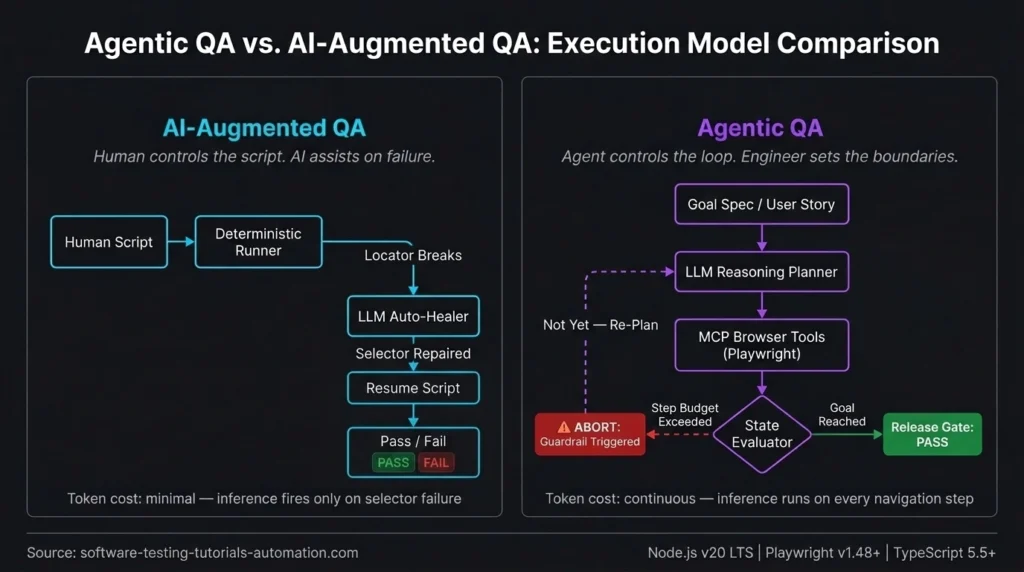
The difference between AI-augmented QA and agentic QA is not a marketing distinction; it is an architectural one with real consequences for your CI/CD budget and your release pipeline’s stability. AI-augmented QA hands the control loop to a human-authored script and uses AI as a smart repair utility. Agentic QA hands the control loop to an autonomous reasoning agent that decides, at runtime, what to click, where to navigate, and when the goal is achieved.
Here’s the catch: that second model is extraordinarily powerful and extraordinarily dangerous without structural guardrails. I’ve watched a single unconstrained agentic smoke test consume $55 in LLM inference tokens and generate 53 phantom orders in a shared staging database on a single pull request run. That incident is the centerpiece of this guide.
This article gives you the architectural context, the failure postmortem, and a production-ready TypeScript harness with hard execution boundaries you can drop into your Playwright suite today.
- Agentic QA vs. AI-Augmented QA: What Actually Changes
- Why Unconstrained Agents Break Enterprise CI/CD Pipelines
- 3-Part Bug Postmortem: The $55 Runaway Staging Loop
- Engineering Execution Boundaries: The 4 Pillars of Safe Agentic Testing
- Hands-On: A Production-Hardened Agent Guardrail in Playwright & TypeScript
- The SDET Career Shift: Governing Autonomous Systems Is the New High-Leverage Skill
- Key Takeaways
- Take the Next Step in Autonomous QA
Agentic QA vs. AI-Augmented QA: What Actually Changes
The core difference is who drives the control loop and how failure is handled.
In an AI-augmented setup, a human SDET writes the test scenario in full. The AI acts as infrastructure, surfacing a healed locator when a CSS selector breaks, or generating a boilerplate data-testid fill sequence. The script remains deterministic, linear, and binary: pass or fail.
In an agentic framework, the SDET writes a goal, not a script. The agent uses a reasoning loop (backed by an LLM and browser tool primitives exposed through the Model Context Protocol (MCP)) to plan each step dynamically. It inspects the live accessibility tree, decides what control to interact with, executes the action, re-evaluates state, and repeats until the goal condition is reached or a budget is exhausted.
The Two Execution Models at a Glance:
- AI-Augmented QA (Linear Execution):
Human Script->Deterministic Runner->(Locator Breaks) LLM Heals Selector->Resume Execution->Pass/Fail - Agentic QA (Autonomous Reasoning Loop):
Goal Specification->Agent Reasoning Loop->MCP Tool Dispatch (Playwright)->State Evaluation->Goal Reached?(If not, re-plan and loop)
That cyclic re-planning loop makes agentic QA exceptionally powerful for dynamic UIs, yet dangerous without a governor.
| Capability | AI-Augmented QA (Co-pilot Pattern) | Agentic QA (Autonomous Goal Pattern) |
|---|---|---|
| Control Loop Owner | Human-authored script | Autonomous LLM reasoning agent |
| Execution Path | Linear, deterministic (Step A → B → C) | Dynamic, adaptive – re-planned each step |
| Locator Strategy | Hardcoded CSS/XPath + heuristic fallback | Accessibility tree semantic inspection + visual cues |
| Failure Response | Flags assertion; patches locator registry | Re-plans route; explores alternative UI paths |
| Pipeline Reliability | High: binary pass/fail, predictable runtime | Variable without hard step budgets and timeouts |
| Token Cost Profile | Near-zero: inference fires only on locator failure | Continuous: inference runs on every navigation step |
| Primary Risk | Brittle scripts after major DOM refactors | Non-deterministic runs, runaway loops, staging pollution |
| Best Fit | High-volume regression, smoke gates, nightly runs | Complex exploratory flows, dynamic layout transitions |
AI-augmented tools shine in stable, high-volume regression suites. After a major DOM refactor, such as a multi-page checkout collapsing into a single-page accordion widget, those AI-augmented scripts shatter because the procedural sequence no longer maps to the real UI. That’s where agentic QA earns its place: the agent re-evaluates the live accordion, discovers the new interaction pattern, and completes the goal without a human rewriting the test.
The critical engineering challenge shifts entirely. Instead of maintaining CSS selectors, you’re containing the agent’s decision space.
Why Unconstrained Agents Break Enterprise CI/CD Pipelines
Autonomous testing agents operate on probabilistic reasoning. CI/CD pipelines operate on deterministic binary gates. Those two things are in fundamental tension, and the gap is where your worst incidents will happen.
When an agent hits an unexpected condition (such as a promotion modal, session expiry, or slow microservice), its default instinct is to explore and problem-solve. In a production-like staging environment with live-ish data, that exploratory drive is catastrophic.
Three failure modes appear most frequently when teams deploy unconstrained agents into GitHub Actions runners:
- The Infinite Exploration Loop. A target element is slow to render due to a backend microservice lag spike. The agent, not finding the expected control, begins clicking surrounding buttons and links to satisfy its goal prompt. This cycles through hundreds of micro-actions, chewing runner concurrency and burning your LLM token budget.
- Staging State Contamination. An agent tasked with verifying order history navigates to billing settings, repeatedly triggers test transactions, spams transactional webhook queues, and corrupts shared seed fixtures that other CI jobs depend on.
- Semantic Assertion Drift. Given an open-ended validation prompt, an agent encountering a 500 error page with friendly copy (“Something went wrong, please try again!”), it may rationalize that the application handled the user state gracefully and mark the run as passed. This is the most dangerous failure because it’s invisible.
Don’t make the rookie mistake of assuming modern agentic tools naturally know when to stop.
3-Part Bug Postmortem: The $55 Runaway Staging Loop
This is a real postmortem. One PR smoke test. One front-end refactor. One unguarded agent.
Symptom & Terminal Log
[FATAL] 2026-10-12T03:42:19.102Z | CI Runner: github-runner-qa-18
Job: 'agentic-e2e-checkout' [Killed by system supervisor]
Reason: Execution exceeded hard timeout (60 minutes)

Total LLM Tokens Consumed : 184,520
Estimated Inference Cost  : $55.35  (single PR run)
Database Anomalies        : 53 pending test orders (user: 'agent-worker-01')
Runner Concurrency Blocked: 4 parallel jobs queued, waiting on deadlocked runner
A pull request smoke test for a checkout flow timed out after a full 60 minutes. It blocked four other queued CI jobs. It generated a $55 LLM invoice for a single build check. It left 53 phantom orders in the shared staging database, breaking the seed fixtures that three other teams’ integration tests depended on the next morning.
Root Cause
A front-end team pushed a refactor that delayed the visibility of the primary “Submit Order” button by 400 milliseconds. This was a legitimate network-idle delay introduced by a new coupon validation API call. The agent, operating without a wait strategy, concluded that the checkout flow was blocked by incomplete form fields. Rather than asserting a timeout and failing fast, it navigated back to the cart page, added new items, and re-attempted the checkout pipeline 53 consecutive times in an attempt to reach the order confirmation screen.
The LLM’s reasoning loop was coherent but wrong: each attempt looked like a valid recovery strategy to the model, because no hard constraint existed to terminate the run.
Production Fix
We implemented three mandatory controls in parallel:
- Hard step budget of 8 tool actions per goal. Any run exceeding 8 browser interactions throws immediately with a
GUARDRAIL_EXCEEDEDerror code that maps to a distinct CI failure state. - URL blast-radius containment. The agent is mechanically blocked from navigating outside the
/checkout/*URL pattern via a route interceptor. Cart and billing routes throw aSECURITY_VIOLATIONerror on any navigation attempt. - Deterministic completion anchor. Success is defined by
await expect(page.locator('[data-testid="order-confirmed-banner"]')).toBeVisible()– a hard Playwright locator assertion, not an LLM self-evaluation prompt.
The fix went live the next sprint. Subsequent runs averaged 6 steps and under 4,000 tokens each.
Engineering Execution Boundaries: The 4 Pillars of Safe Agentic Testing
To extract real value from agentic QA without torching pipeline reliability, every autonomous agent harness needs four structural constraints. Give the agent freedom in how it explores the UI. Give it zero freedom over how far it strays or how success is graded.
The 5-Layer Execution Boundary Architecture:
- Goal Specification: High-level user story and mission assigned to the autonomous agent.
- Step Budget Governor: Hard browser action cap (6 to 12 steps). Exceeding this budget throws an immediate timeout failure.
- Blast-Radius URL Filter: Network-level route interceptor. Route violations trigger an immediate security abort.
- Playwright MCP Tool Dispatch: Executes approved browser actions (
click,fill,navigate) with strict per-action timeouts. - Immutable Telemetry & Deterministic Anchors: Records full audit logs for SOC 2 compliance, and anchors final pass/fail decisions to web-first Playwright assertions (
await expect(locator).toBeVisible()).
1. Hard Step and Token Budgets
Every testing mission gets a fixed step budget (typically 6 to 12 browser actions for a scoped flow) and a hard token cap enforced at the environment variable level. If the agent can’t reach a verified state within budget, the run fails immediately with a descriptive trace. A step budget forces the LLM planner to be precise; sloppy goal prompts surface quickly when every wasted click costs you a step.
2. Blast-Radius URL Containment
An agent assigned to test user profile editing must be mechanically blocked from ever touching billing portals, admin deletion screens, or external OAuth redirects. Route interceptors, not just prompt instructions, enforce this. Prompt-level restrictions are ignored by models under inference pressure. Code-level interceptors are not.
3. Separation of Exploration from Assertion (Deterministic Anchors)
This is the most violated rule in early agentic QA implementations. The agent navigates; Playwright asserts. The LLM never grades its own test run. Anchor every pass/fail decision to web-first Playwright assertions (await expect(locator).toBeVisible()) or explicit backend contract validations from your API response payload. Explore how deterministic test caching combines hybrid AST execution with deterministic replay to eliminate this drift entirely.
4. Immutable Execution Telemetry
Every agent action – every selector inspected, every tool call dispatched, every reasoning trace generated – writes to an immutable audit log that the Playwright Trace Viewer can parse. When an agent flags a failure, your SDET inspects a side-by-side view: the Playwright snapshot trace and the model’s reasoning scratchpad. This distinguishes a true regression from an agent pathfinding error, satisfying SOC 2 Type II audit requirements for automated process controls.
Hands-On: A Production-Hardened Agent Guardrail in Playwright & TypeScript
The harness below is what we deploy across staging environments. It enforces hard step budgets, enforces URL containment via Playwright route interception (not just config guards), logs every action to a structured telemetry ledger, and separates agent-driven navigation from deterministic Playwright assertions.
Tested with: Node.js v20 LTS | Playwright v1.48+ | TypeScript 5.5+
// AgentExecutionGuardrail.ts
import { Page, Locator, expect } from '@playwright/test';

// ---------------------------------------------------------------------------
// Types
// ---------------------------------------------------------------------------

export type AllowedActionType = 'click' | 'fill' | 'navigate' | 'select' | 'waitForSelector';

export interface AgentAction {
  type: AllowedActionType;
  targetSelector?: string;
  payload?: string;
  url?: string;
}

export interface GuardrailConfig {
  /** Maximum number of browser tool-calls permitted before hard abort. */
  maxSteps: number;
  /** URL patterns the agent is allowed to navigate to. All others are blocked. */
  allowedUrlPatterns: RegExp[];
  /** Per-action timeout in milliseconds - applies to clicks, fills, and navigation. */
  actionTimeoutMs: number;
  /** Structured telemetry destination. Defaults to console; swap for your audit sink. */
  logSink?: (entry: TelemetryEntry) => void;
}

export interface TelemetryEntry {
  stepIndex: number;
  maxSteps: number;
  actionType: AllowedActionType | 'navigate';
  targetSelector?: string;
  url?: string;
  reasoning: string;
  timestampIso: string;
  status: 'dispatched' | 'blocked_budget' | 'blocked_url' | 'blocked_action_type';
}

// ---------------------------------------------------------------------------
// AgentExecutionGuardrail
// ---------------------------------------------------------------------------

export class AgentExecutionGuardrail {
  private currentStep = 0;
  private readonly telemetryLog: TelemetryEntry[] = [];
  private isRouteInterceptorActive = false;

  constructor(
    private readonly page: Page,
    private readonly config: GuardrailConfig
  ) {}

  /**
   * Lazily installs and awaits Playwright route interception on the first action.
   * This guarantees the network layer sandbox is active before any navigation or click occurs.
   */
  private async ensureRouteInterceptor(): Promise<void> {
    if (this.isRouteInterceptorActive) return;

    await this.page.route('**/*', async (route) => {
      const requestUrl = route.request().url();
      const isAllowed = this.config.allowedUrlPatterns.some((pattern) => {
        pattern.lastIndex = 0;
        return pattern.test(requestUrl);
      });
      // Always permit non-navigation resource loads (JS, CSS, images, API calls).
      const isNavigationRequest = route.request().resourceType() === 'document';

      if (isNavigationRequest && !isAllowed) {
        const entry = this.buildTelemetryEntry('navigate', 'blocked_url', {
          url: requestUrl,
          reasoning: '[SYSTEM] Blocked by URL blast-radius interceptor',
        });
        this.emit(entry);
        // Abort the navigation; the agent receives a network error it cannot ignore.
        await route.abort('blockedbyclient');
        return;
      }

      await route.continue();
    });

    this.isRouteInterceptorActive = true;
  }

  // ---------------------------------------------------------------------------
  // Core Dispatch
  // ---------------------------------------------------------------------------

  /**
   * Execute a single agent-decided action through all guardrail layers.
   * Every call is logged to the immutable telemetry ledger before execution.
   *
   * @param action   - The browser action proposed by the LLM planner.
   * @param reasoning - The model's stated rationale (captured for audit logs).
   */
  async executeBoundedAction(action: AgentAction, reasoning: string): Promise<void> {
    await this.ensureRouteInterceptor();
    this.currentStep++;

    // -- Guardrail 1: Hard Step Budget ----------------------------------------
    if (this.currentStep > this.config.maxSteps) {
      this.emit(
        this.buildTelemetryEntry(action.type, 'blocked_budget', {
          targetSelector: action.targetSelector,
          url: action.url,
          reasoning,
        })
      );
      throw new Error(
        `[GUARDRAIL_EXCEEDED] Agent hit max step budget (${this.config.maxSteps}). ` +
          `Run aborted at step ${this.currentStep}. Review telemetry: ${JSON.stringify(this.telemetryLog, null, 2)}`
      );
    }

    // -- Guardrail 2: Navigation URL Containment (code-level, not prompt-level) --
    if (action.type === 'navigate') {
      if (!action.url) {
        throw new Error(`[ACTION_REJECTED] Action type 'navigate' requires a valid 'url'.`);
      }
      const isAllowed = this.config.allowedUrlPatterns.some((p) => {
        p.lastIndex = 0;
        return p.test(action.url!);
      });
      if (!isAllowed) {
        this.emit(
          this.buildTelemetryEntry('navigate', 'blocked_url', {
            url: action.url,
            reasoning,
          })
        );
        throw new Error(
          `[SECURITY_VIOLATION] Navigation to '${action.url}' blocked by blast-radius boundary.`
        );
      }

      this.emit(
        this.buildTelemetryEntry('navigate', 'dispatched', {
          url: action.url,
          reasoning,
        })
      );
      await this.page.goto(action.url, {
        timeout: this.config.actionTimeoutMs,
        waitUntil: 'networkidle', // Prevents the 400ms delay race condition from the postmortem.
      });
      return;
    }

    // -- Guardrail 3: Safe Interaction Primitives with Web-First Auto-Waiting --
    const allowedInteractions: AllowedActionType[] = ['click', 'fill', 'select', 'waitForSelector'];
    if (!allowedInteractions.includes(action.type)) {
      this.emit(
        this.buildTelemetryEntry(action.type, 'blocked_action_type', {
          targetSelector: action.targetSelector,
          reasoning,
        })
      );
      throw new Error(
        `[ACTION_REJECTED] Action type '${action.type as string}' is not in the allowed action allowlist.`
      );
    }

    if (!action.targetSelector) {
      throw new Error(`[ACTION_REJECTED] Action type '${action.type}' requires a targetSelector.`);
    }

    this.emit(
      this.buildTelemetryEntry(action.type, 'dispatched', {
        targetSelector: action.targetSelector,
        reasoning,
      })
    );

    const target: Locator = this.page.locator(action.targetSelector).first();

    switch (action.type) {
      case 'click':
        // Web-first: Playwright auto-waits for the element to be visible, enabled, and stable.
        await target.click({ timeout: this.config.actionTimeoutMs });
        break;

      case 'fill':
        await target.fill(action.payload ?? '', { timeout: this.config.actionTimeoutMs });
        break;

      case 'select':
        await target.selectOption(action.payload ?? '', { timeout: this.config.actionTimeoutMs });
        break;

      case 'waitForSelector':
        // Explicit wait-for visibility; use when the agent needs to confirm state before proceeding.
        await target.waitFor({ state: 'visible', timeout: this.config.actionTimeoutMs });
        break;
    }
  }

  // ---------------------------------------------------------------------------
  // Deterministic Assertion Anchor
  // ---------------------------------------------------------------------------

  /**
   * NEVER let the LLM grade its own test run.
   * Call this method to anchor pass/fail to a deterministic Playwright assertion.
   * The agent drives; Playwright judges.
   *
   * @param expectedLocator - The ground-truth element that must be visible on success.
   * @param description     - Human-readable description for telemetry and failure messages.
   */
  async assertDeterministicState(expectedLocator: Locator, description: string): Promise<void> {
    // Hard 5-second window: if the goal state isn't visible, the test fails immediately.
    await expect(expectedLocator).toBeVisible({ timeout: 5000 });
    console.log(`[ASSERTION_PASSED] [PASS] ${description}`);
    console.log(`[TELEMETRY_SUMMARY] Completed in ${this.currentStep}/${this.config.maxSteps} steps.`);
  }

  // ---------------------------------------------------------------------------
  // Audit Helpers
  // ---------------------------------------------------------------------------

  /** Returns the full immutable telemetry ledger for SOC 2 audit export. */
  getExecutionLedger(): Readonly<TelemetryEntry[]> {
    return Object.freeze([...this.telemetryLog]);
  }

  private buildTelemetryEntry(
    actionType: AllowedActionType | 'navigate',
    status: TelemetryEntry['status'],
    meta: { targetSelector?: string; url?: string; reasoning: string }
  ): TelemetryEntry {
    return {
      stepIndex: this.currentStep,
      maxSteps: this.config.maxSteps,
      actionType,
      targetSelector: meta.targetSelector,
      url: meta.url,
      reasoning: meta.reasoning,
      timestampIso: new Date().toISOString(),
      status,
    };
  }

  private emit(entry: TelemetryEntry): void {
    this.telemetryLog.push(entry);
    if (this.config.logSink) {
      this.config.logSink(entry);
    } else {
      console.log(
        `[Step ${entry.stepIndex}/${entry.maxSteps}] ${entry.status.toUpperCase()} | ` +
          `${entry.actionType}${entry.url ? ' -> ' + entry.url : ''}${entry.targetSelector ? ' @ ' + entry.targetSelector : ''} | ` +
          `Reasoning: ${entry.reasoning}`
      );
    }
  }
}
Running the Bounded Agent in a Playwright Test Suite
The test below illustrates the core pattern: an LLM planner proposes actions, but every single interaction routes through executeBoundedAction(). If the model tries to navigate outside the checkout domain or exhausts its step budget, the runner trips the circuit breaker immediately. This prevents runaway loops, phantom orders, and surprise invoices.
// e2e-agentic-checkout.spec.ts
import { test } from '@playwright/test';
import { AgentExecutionGuardrail, AgentAction } from './AgentExecutionGuardrail';

test('autonomous agent: bounded checkout flow with execution guardrails', async ({ page }) => {
  // Configure the guardrail harness.
  // In a real implementation, plannedActions are returned dynamically by your LLM/MCP client.
  const guardrail = new AgentExecutionGuardrail(page, {
    maxSteps: 8,
    // Strict blast-radius: agent is sandboxed to the checkout domain only.
    allowedUrlPatterns: [/^https:\/\/staging\.mystore\.internal\/checkout/],
    actionTimeoutMs: 4000,
  });

  // Step 1: Navigate into the checkout funnel (waitUntil: 'networkidle' prevents the
  // 400ms delay race condition documented in the postmortem above).
  await guardrail.executeBoundedAction(
    { type: 'navigate', url: 'https://staging.mystore.internal/checkout/start' },
    'Navigating to the staging checkout funnel entry point'
  );

  // Steps 2-N: Simulated LLM-planned action sequence.
  // In production, this array is populated by your MCP client response - each object
  // is one tool call returned by the agent's reasoning loop.
  const plannedActions: AgentAction[] = [
    {
      type: 'fill',
      targetSelector: 'input[name="shipping-email"]',
      payload: 'qa-agent@internal.test',
    },
    {
      type: 'fill',
      targetSelector: 'input[name="shipping-address"]',
      payload: '123 Test Lane, Austin, TX 78701',
    },
    {
      type: 'click',
      targetSelector: 'button[data-testid="continue-to-shipping"]',
    },
    {
      type: 'waitForSelector',
      targetSelector: '[data-testid="shipping-options-panel"]',
    },
    {
      type: 'click',
      targetSelector: 'input[data-testid="shipping-standard"]',
    },
    {
      type: 'click',
      targetSelector: 'button[data-testid="submit-order"]',
    },
  ];

  for (const action of plannedActions) {
    await guardrail.executeBoundedAction(action, 'Agent executing LLM-planned user path');
  }

  // Deterministic Ground-Truth Anchor.
  // The agent navigated. Playwright judges.
  const orderConfirmedBanner = page.locator('[data-testid="order-confirmed-banner"]');
  await guardrail.assertDeterministicState(
    orderConfirmedBanner,
    'Order confirmation banner visible: checkout flow completed successfully'
  );

  // Optional: export the immutable telemetry ledger for CI artifact storage or SOC 2 audit.
  const ledger = guardrail.getExecutionLedger();
  console.log('[AUDIT_LEDGER]', JSON.stringify(ledger, null, 2));
});
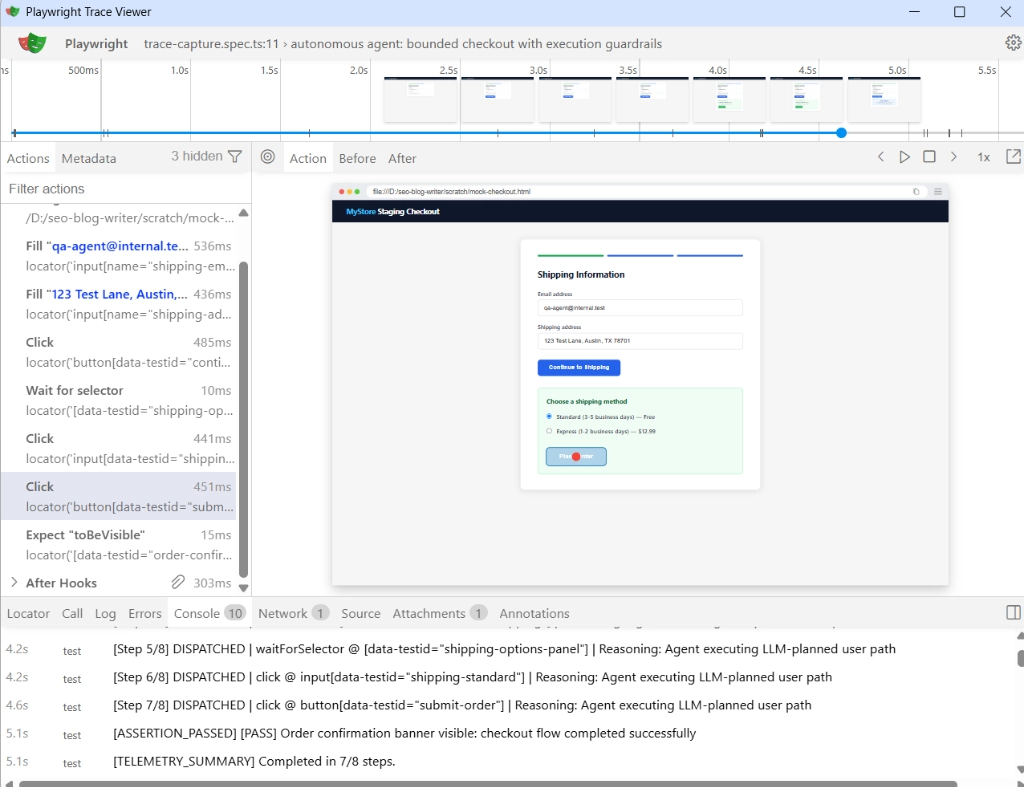
Production CI/CD Workflow with Hard Execution Gating
Configure your GitHub Actions workflow with aggressive runner timeouts, structured trace retention, and environment-level token caps. The timeout-minutes: 15 ceiling at the job level is your last line of defense against runaway billing if an agent somehow slips past the code-level guardrails.
# .github/workflows/agentic-qa.yml
name: Agentic E2E Regression Suite

on:
  pull_request:
    branches: [main]

jobs:
  agentic-test:
    runs-on: ubuntu-latest
    timeout-minutes: 15  # Hard CI ceiling: prevents runaway LLM billing at the infra layer.
    concurrency:
      group: ${{ github.workflow }}-${{ github.ref }}
      cancel-in-progress: true  # Kill stale PR runs immediately; don't queue up duplicate agents.

    steps:
      - name: Check out repository
        uses: actions/checkout@v4

      - name: Set up Node.js v20 LTS
        uses: actions/setup-node@v4
        with:
          node-version: 20
          cache: 'npm'

      - name: Install dependencies
        run: npm ci

      - name: Install Playwright browsers
        run: npx playwright install --with-deps chromium

      - name: Run bounded agentic test suite
        run: npx playwright test e2e-agentic-checkout.spec.ts --reporter=html
        env:
          LLM_API_KEY: ${{ secrets.AGENTIC_QA_API_KEY }}
          # Hard token ceiling enforced at the MCP client initialization layer.
          LLM_MAX_TOKENS_PER_RUN: 25000

      - name: Upload Playwright execution traces and audit ledger
        if: always()  # Upload on failure too: you need the trace to diagnose agent pathfinding errors.
        uses: actions/upload-artifact@v4
        with:
          name: agentic-trace-results-${{ github.run_id }}
          path: |
            playwright-report/
            test-results/
          retention-days: 14
The SDET Career Shift: Governing Autonomous Systems Is the New High-Leverage Skill
The fear that autonomous testing agents will make QA Engineers obsolete reflects a fundamental misunderstanding of what enterprise software delivery actually requires. Agents excel at navigating dynamic interfaces and discovering unmapped interaction paths. They have zero intrinsic grasp of business risk, regulatory compliance thresholds, or architectural resilience requirements.
In production pipelines, the QA engineers who will own the room are the ones who can govern autonomous systems, not the ones who can write the most locators.
When your team adopts agentic QA, the work that currently consumes 60% of a typical SDET’s week (DOM tree inspection, CSS selector patching, and brittle timing workarounds) disappears. The role evolves into three high-leverage engineering functions:
- Quality Policy Architect. Designing the execution boundaries, step thresholds, URL sandboxes, and fallback criteria that prevent autonomous systems from destabilizing shared staging environments. This is systems design work, not test maintenance.
- Evaluation Engineer. Building robust semantic assertion benchmarks, ground-truth evaluation corpora, and hybrid assertion strategies that combine web-first Playwright locators with backend contract validations. See our walkthrough on building an LLM evaluation framework for a deep dive into semantic similarity metrics and probabilistic test reliability.
- Security & Compliance Auditor. Ensuring autonomous testing bots don’t exfiltrate PII-adjacent DOM snapshots to external LLM inference endpoints, don’t violate HIPAA data handling rules in healthcare staging environments, and maintain immutable execution logs that satisfy SOC 2 Type II audit requirements. Read our guide on maintaining SOC 2 and HIPAA compliance with autonomous testing agents for the full enterprise framework.
Engineering teams don’t need fewer QA Engineers in an agentic world. They need QA professionals who think like platform engineers, designing the guardrails rather than just running scripts.
Key Takeaways
- Architectural divergence is real. AI-augmented QA accelerates human-scripted workflows via selector healing and boilerplate generation. Agentic QA executes open-ended goal-oriented missions using autonomous LLM reasoning loops exposed through MCP tool primitives.
- Unconstrained agents are production incidents waiting to happen. Without hard governors, a single misconfigured smoke test can burn $55 in tokens, generate 53 phantom orders, and block four CI jobs on a single PR.
- Four mandatory guardrails: hard step budgets, blast-radius URL containment via Playwright route interceptors (not just prompt instructions), strict separation of agent navigation from deterministic Playwright assertion anchors, and immutable telemetry ledgers for SOC 2 audit compliance.
- Never let the LLM grade its own test run. Anchor every pass/fail decision to
await expect(locator).toBeVisible()or an explicit API contract payload, never to the agent’s subjective self-evaluation. - The SDET role is evolving upward. The highest-leverage work shifts from locator maintenance to execution boundary design, semantic evaluation engineering, and enterprise compliance governance.
Frequently Asked Questions
What is the difference between AI-assisted testing and agentic testing?
AI-assisted testing keeps the human engineer in full control: the AI generates code snippets or repairs broken selectors within a rigid, deterministic script. Agentic testing hands the agent a high-level goal and lets it independently plan, execute, and adapt at runtime without any pre-scripted step sequence. The control loop ownership is the key distinction.
How do you prevent an autonomous QA agent from running indefinitely?
Wrap the agent’s action dispatch in a hard step budget governor (typically 8 to 12 browser actions per scoped mission). Install a Playwright route interceptor to enforce URL blast-radius at the network layer. Set an aggressive timeout-minutes ceiling on your CI runner job. All three layers together prevent any single failure mode from allowing a runaway loop.
Can agentic testing completely replace traditional Playwright or Cypress automation?
No, and it should not. High-volume regression suites, nightly smoke runs, and critical release gates require the speed, minimal token cost, and deterministic repeatability of traditional Playwright scripts. Agentic testing is the right tool for complex exploratory flows, dynamic layout transitions, and requirement-driven discovery across fast-moving feature branches.
How do autonomous testing agents handle unexpected UI changes without breaking?
Instead of brittle CSS or XPath selectors, agentic tools evaluate the rendered interface using the accessibility tree and visual perception. When a checkout flow redesigns from a multi-page form to an accordion widget, the agent inspects the live DOM, infers the new interaction pattern, and reroutes to the goal without human selector patching.
Does agentic QA introduce security or compliance risks in staging environments?
Yes, if unconstrained. Autonomous agents can inadvertently submit PII-adjacent form data to external LLM inference endpoints embedded in the tool layer, trigger real payment webhooks in staging environments with live-adjacent configs, or violate HIPAA data handling rules when DOM snapshots contain PHI. Mitigate these risks by enforcing strict URL sandboxing at the Playwright route interceptor layer, running agents inside isolated VPCs with egress controls, and stripping sensitive data before feeding DOM snapshots to external model providers.
Take the Next Step in Autonomous QA
Brittle locator scripts bottlenecking your sprint delivery? Start with one high-maintenance regression flow. Wrap your existing Playwright test in the AgentExecutionGuardrail harness above, set a conservative maxSteps: 6, and run your first bounded agentic experiment against staging.
When that run completes deterministically (same result, every time, under budget), you will understand exactly what the architectural shift actually means in practice.