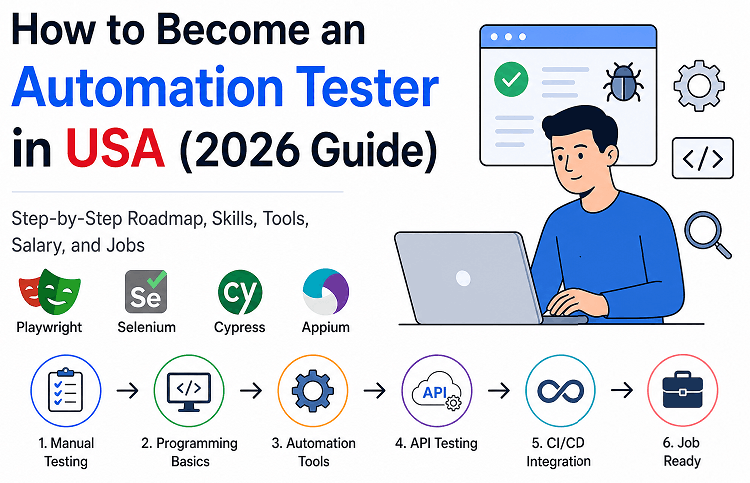
Becoming an automation tester in USA in 2026 is one of the best career options for people entering software testing or switching from manual testing. Most entry level automation testers in the USA earn between $70,000 and $100,000 per year, while experienced automation engineers can earn more than $140,000 annually. Companies across healthcare, fintech, ecommerce, SaaS, and AI industries are actively hiring automation testing professionals.
The path to becoming an automation tester is more practical than many beginners think. You do not need a computer science degree from a top university to start. What matters most is learning automation testing tools, understanding real testing workflows, and building hands-on projects using tools like Playwright, Selenium, Cypress, Java, or Python.
In 2026, companies in the USA are focusing heavily on faster releases, AI assisted testing, CI/CD pipelines, and quality engineering. Because of this shift, automation testers with real project skills are in high demand. This guide explains everything step by step, including required skills, learning roadmap, salary expectations, certifications, tools, job roles, and mistakes to avoid.
- How to Become an Automation Tester in USA in 2026?
- What Does an Automation Tester Do?
- Which Skills Are Required to Become an Automation Tester?
- Step by Step Roadmap to Become an Automation Tester
- Which Automation Testing Tools Should Beginners Learn?
- What Programming Language Is Best for Automation Testing?
- Best Certifications for Automation Testers
- Automation Tester Salary in USA
- How to Get Your First Automation Testing Job in USA?
- How to Increase Your Automation Tester Salary Faster?
- What Is the Future of Automation Testing in USA?
- Internal Resources to Help You Learn Automation Testing
- How to Become an Automation Tester Without Experience
- Common Mistakes Beginners Make While Learning Automation Testing
- How to Become a Playwright Automation Tester in USA
- Real Industry Experience Note
- Conclusion
- FAQs
How to Become an Automation Tester in USA in 2026?
To become an automation tester in USA in 2026, learn software testing fundamentals, one programming language, automation tools like Playwright or Selenium, API testing, CI/CD basics, and build real automation projects. Most beginners become job ready within 6 to 12 months through structured hands on practice.
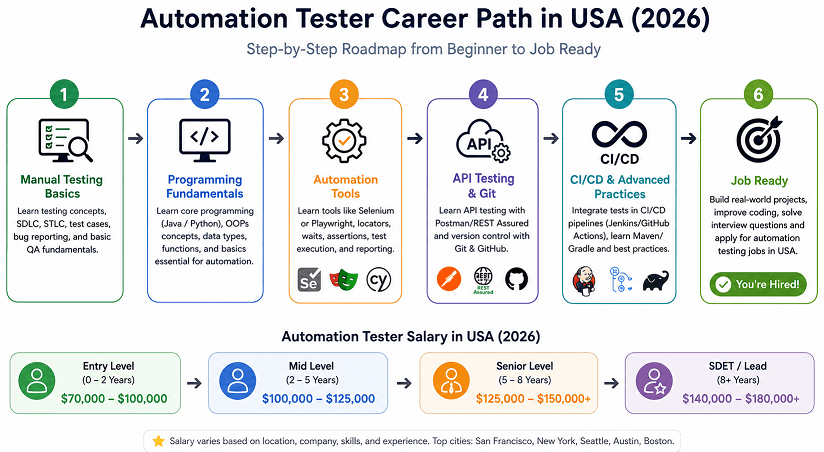
This roadmap shows how beginners can gradually move from testing fundamentals to advanced automation skills required in real USA tech companies.
Automation testers in the USA usually work on web applications, APIs, mobile apps, ecommerce platforms, banking systems, and cloud applications. Companies prefer candidates who can automate repetitive testing tasks and improve software release speed.
| Career Area | Details |
|---|---|
| Average Entry Salary | $70,000 to $100,000 per year |
| Experienced Salary | $120,000 to $140,000+ per year |
| Top Skills | Playwright, Selenium, Java, Python, API Testing |
| Top Hiring Industries | Fintech, SaaS, Healthcare, Ecommerce, AI |
| Common Job Titles | Automation Tester, QA Automation Engineer, SDET |
- Learn software testing fundamentals
- Understand test cases and bug reporting
- Learn one programming language well
- Choose one automation testing tool
- Build real automation projects
- Learn API testing and CI/CD basics
- Create a strong GitHub portfolio
- Apply for internships and junior QA roles
What Does an Automation Tester Do?
An automation tester creates automated scripts to validate software functionality, reduce repetitive manual testing, and improve software release quality.
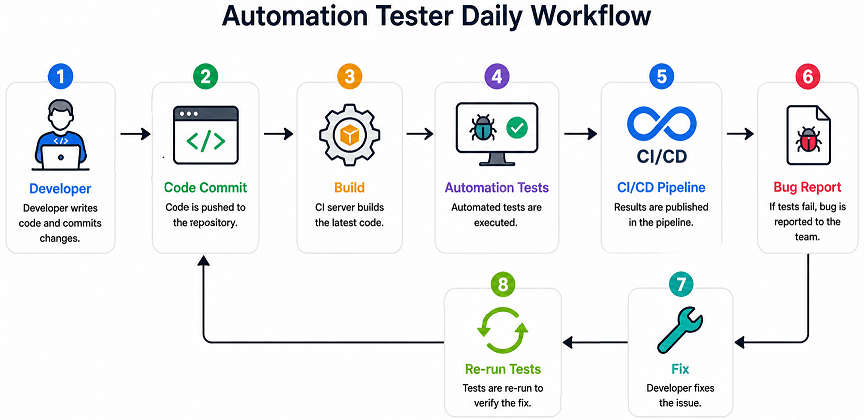
This workflow shows how automation testers interact with development and DevOps teams in real production environments.
In modern software companies, automation testing is no longer limited to writing simple scripts. Automation testers now work closely with developers, DevOps teams, product managers, and QA engineers to build reliable testing pipelines for web applications, APIs, mobile apps, and cloud platforms.
Simply put, an automation tester replaces repetitive manual testing tasks with automated workflows. This helps companies release software faster while maintaining quality.
Daily Responsibilities of an Automation Tester
- Write automated test scripts for web and API testing
- Maintain existing automation frameworks
- Identify bugs and report issues clearly
- Review failed test executions
- Work with CI/CD pipelines like Jenkins or GitHub Actions
- Perform regression testing before releases
- Validate application performance and stability
- Collaborate with developers and product teams
Common Automation Testing Tools Used in USA Companies
| Tool | Main Usage |
|---|---|
| Playwright | Modern web automation testing |
| Selenium | Cross browser automation testing |
| Cypress | Frontend web application testing |
| Postman | API testing and validation |
| Jenkins | CI/CD automation pipeline |
| GitHub Actions | Automated test execution workflows |
Different automation tools are used based on project type, technology stack, and company requirements.
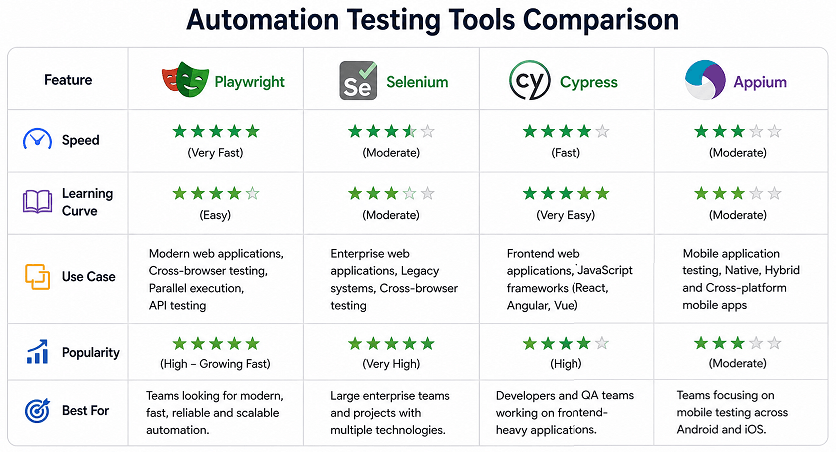
This comparison helps beginners choose the right automation tool based on real industry usage instead of confusion.
Is Automation Testing a Good Career in USA?
Yes. Automation testing is considered one of the fastest growing QA career paths in the USA. Companies are investing heavily in test automation because software releases are becoming more frequent. Professionals with automation testing skills often receive better salaries and faster career growth compared to purely manual testing roles.
Which Skills Are Required to Become an Automation Tester?
To become an automation tester in USA, you need a combination of testing knowledge, programming skills, automation tools, and real project experience. Companies usually look for candidates who can understand software behavior, write reliable automation scripts, and troubleshoot failures efficiently.
The good news is that beginners do not need to learn everything at once. Most successful automation testers build skills step by step while working on small projects and real testing scenarios.
1. Software Testing Fundamentals
Before learning automation tools, you must understand software testing basics. Strong testing knowledge helps you create better automation scripts and identify real application issues.
- Test cases and test scenarios
- Bug lifecycle and defect tracking
- Regression testing
- Smoke testing
- Functional testing
- Integration testing
- Agile and Scrum basics
2. Programming Skills
Programming is one of the most important automation testing skills. You do not need advanced software engineering knowledge initially, but you should be comfortable writing functions, loops, conditions, and reusable automation code.
| Programming Language | Why It Is Popular |
|---|---|
| Java | Widely used with Selenium in enterprise companies |
| Python | Easy for beginners and useful for API automation |
| JavaScript | Popular for Playwright and Cypress automation |
| TypeScript | Increasingly used in modern automation frameworks |
3. Automation Testing Tools
Learning at least one automation testing framework is essential. In 2026, Playwright is rapidly growing because of its speed, reliability, and modern browser automation features.
- Playwright
- Selenium WebDriver
- Cypress
- Appium
- TestNG or JUnit
4. API Testing Skills
Modern applications rely heavily on APIs. Because of this, automation testers with API testing knowledge are often preferred during hiring.
- REST API testing
- Postman usage
- JSON validation
- Status code verification
- Authentication handling
5. CI/CD and DevOps Basics
Many companies in the USA expect automation testers to integrate test suites with deployment pipelines. Even beginner level understanding of CI/CD can improve job opportunities significantly.
- Jenkins
- GitHub Actions
- Git and GitHub
- Docker basics
- Automated test execution pipelines
6. Real Project Experience
Many beginners make the mistake of only watching tutorials. However, companies usually hire candidates who can demonstrate practical automation skills using real projects.
Creating small automation projects on GitHub can make your profile much stronger, especially if you have no prior IT experience.
Can You Become an Automation Tester Without Experience?
Yes. Many entry level automation testers start without prior industry experience. Building projects, learning automation frameworks, practicing interview questions, and understanding real testing workflows can help beginners enter the QA automation field successfully.
Step by Step Roadmap to Become an Automation Tester
The best way to become an automation tester in USA is to follow a structured learning roadmap instead of randomly learning tools. A step by step approach helps beginners avoid confusion and build practical skills that companies actually expect during interviews.
In short, focus first on testing fundamentals, then programming, automation tools, frameworks, API testing, and finally real world project experience.
Step 1: Learn Manual Testing Basics
Many beginners try to start directly with automation tools. However, strong manual testing knowledge is extremely important because automation testing is built on testing concepts.
- Understand SDLC and STLC
- Learn test case writing
- Practice bug reporting
- Understand regression and smoke testing
- Learn Agile testing basics
Step 2: Learn One Programming Language
Programming helps automation testers create reusable and maintainable automation frameworks. Beginners should focus on one language first instead of learning multiple languages together.
| Language | Best For |
|---|---|
| Java | Enterprise Selenium automation jobs |
| Python | Easy learning and API automation |
| JavaScript | Playwright and Cypress testing |
| TypeScript | Modern scalable automation frameworks |
Step 3: Choose an Automation Testing Tool
Learning one automation tool deeply is more valuable than learning many tools superficially. In 2026, Playwright is becoming highly popular because it supports fast and stable automation for modern applications.
- Playwright for modern browser automation
- Selenium for enterprise testing environments
- Cypress for frontend testing
- Appium for mobile automation
Step 4: Learn Automation Framework Design
Companies in the USA usually expect automation testers to understand framework structure and reusable automation design. Framework knowledge often separates beginners from job ready candidates.
- Page Object Model
- Data driven framework
- Keyword driven framework
- Reusable utilities and helpers
- Test reporting integration
Step 5: Learn API Testing
Modern automation testing is not limited to UI testing. API testing is one of the most valuable skills because APIs power most web and mobile applications.
- REST APIs
- Postman collections
- API automation basics
- Authentication testing
- JSON schema validation
Step 6: Learn Git and CI/CD Basics
Automation testing in real companies usually runs automatically through pipelines. Understanding CI/CD workflows improves your chances of getting hired.
- Git basics
- GitHub repositories
- Pull requests
- GitHub Actions
- Jenkins pipelines
Step 7: Build Real Projects
Projects are one of the biggest differentiators during automation testing interviews. Many candidates know theory, but fewer candidates can explain real automation implementations.
Try creating projects like:
- Ecommerce website automation
- Login and authentication testing
- API automation framework
- Cross browser testing project
- CI/CD integrated automation suite
Step 8: Prepare for Automation Testing Interviews
Interview preparation should include both theory and practical problem solving. Companies often ask framework questions, coding basics, locator strategies, debugging approaches, and API testing scenarios.
- Practice automation interview questions
- Revise testing concepts
- Understand framework architecture
- Prepare project explanations clearly
- Practice debugging failed tests
How Long Does It Take to Become an Automation Tester?
Most beginners can become job ready within 6 to 12 months with consistent learning and hands-on practice. Candidates who build strong projects and learn modern tools like Playwright often progress faster in the USA job market.
Typical Learning Timeline for Beginners
| Stage | Estimated Time |
|---|---|
| Manual Testing Basics | 2 to 4 weeks |
| Programming Fundamentals | 1 to 2 months |
| Automation Tool Learning | 2 to 3 months |
| API Testing and Git | 1 month |
| Framework Building | 1 to 2 months |
| Interview Preparation | 2 to 4 weeks |
Which Automation Testing Tools Should Beginners Learn?
Choosing the right automation testing tool is one of the most important decisions for beginners. Many people waste months trying to learn too many frameworks together. In reality, most companies prefer strong practical knowledge in one tool instead of basic knowledge in several tools.
In 2026, Playwright, Selenium, and Cypress are among the most demanded automation testing tools in the USA job market. However, the best choice depends on your career goals, target companies, and preferred programming language.
1. Playwright
Playwright is one of the fastest growing automation testing tools for modern web applications. Many companies are moving toward Playwright because of its speed, reliability, parallel execution support, and strong handling of dynamic web elements.
- Supports Chromium, Firefox, and WebKit
- Works with JavaScript, TypeScript, Java, and Python
- Built-in waiting mechanisms reduce flaky tests
- Supports API testing and mobile emulation
- Popular in modern SaaS and startup companies
You can explore the official Playwright documentation to understand installation, browser automation, locators, debugging, and framework setup in detail.
Why Playwright Is Becoming Popular in USA Companies
Many online articles only explain Playwright basics. However, real companies increasingly use Playwright because it simplifies framework maintenance and improves test stability for modern frontend applications.
Playwright also supports features like trace viewer, video recording, network interception, parallel execution, and built-in reporting, which are highly useful in large scale automation projects.
2. Selenium WebDriver
Selenium remains one of the most widely used automation tools in enterprise environments. Large organizations, banks, healthcare systems, and legacy applications still rely heavily on Selenium frameworks.
- Large community support
- Strong enterprise adoption
- Supports multiple browsers
- Works with Java, Python, C#, and more
- Huge number of existing job openings
Selenium remains one of the most established browser automation frameworks used across enterprise testing environments worldwide.
3. Cypress
Cypress is popular for frontend testing and JavaScript focused development teams. Many startups and frontend heavy projects use Cypress because of its fast setup and developer friendly interface.
- Easy beginner setup
- Fast execution speed
- Strong frontend debugging support
- Good for React and Angular applications
Cypress is especially popular among frontend focused engineering teams working with modern JavaScript applications.
4. Appium
Appium is widely used for mobile application automation testing. If you want to work in mobile app testing, Appium knowledge can increase career opportunities significantly.
- Android automation testing
- iOS automation testing
- Cross platform automation support
- Integration with Selenium ecosystem
Playwright vs Selenium for Career Growth
| Feature | Playwright | Selenium |
|---|---|---|
| Learning Curve | Beginner friendly | Moderate |
| Modern Web Support | Excellent | Good |
| Enterprise Adoption | Growing rapidly | Very high |
| Framework Maintenance | Lower maintenance | Higher maintenance |
| Best For | Modern applications | Large enterprise systems |
Which Automation Tool Is Best for Beginners?
For beginners in 2026, Playwright is becoming one of the best choices because it combines modern automation features with easier framework management. However, Selenium still provides excellent job opportunities in enterprise companies.
Simply put, beginners should focus on one tool deeply, create real projects, and understand automation concepts instead of constantly switching frameworks.
What Programming Language Is Best for Automation Testing?
The best programming language for automation testing depends on your career goals, preferred automation tool, and target companies. In the USA job market, Java, Python, JavaScript, and TypeScript are among the most requested languages for automation testing roles.
For beginners, the smartest approach is choosing one language and becoming comfortable with automation scripting, debugging, and framework building before learning additional languages.
Java
Java is still one of the most widely used languages in enterprise automation testing. Many banks, healthcare companies, insurance systems, and large organizations use Java with Selenium frameworks.
- Strong enterprise demand
- Large Selenium ecosystem
- Good long term career stability
- Extensive learning resources available
Python
Python is popular among beginners because of its simple syntax and fast learning curve. Python is also heavily used in API testing, data validation, AI workflows, and backend automation.
- Easy to learn
- Clean readable syntax
- Useful for automation and AI related testing
- Popular in startups and modern tech companies
JavaScript
JavaScript is highly useful for frontend automation testing because modern web applications rely heavily on JavaScript frameworks like React, Angular, and Vue.
- Excellent for Playwright and Cypress
- Useful for frontend focused companies
- Strong demand in SaaS companies
- Allows full stack testing understanding
TypeScript
TypeScript is becoming increasingly important in modern automation frameworks. Many advanced Playwright frameworks use TypeScript because it improves code maintainability and catches errors early.
- Better code structure
- Improved scalability
- Popular in modern automation teams
- Strong future growth potential
Best Language Based on Career Goal
| Career Goal | Recommended Language |
|---|---|
| Enterprise QA Jobs | Java |
| Modern Web Automation | JavaScript or TypeScript |
| Fast Beginner Learning | Python |
| Playwright Automation | TypeScript |
| AI and Automation Integration | Python |
How Much Programming Should an Automation Tester Know?
Automation testers do not need the same level of coding expertise as software developers initially. However, automation testers should comfortably understand:
- Variables and data types
- Functions and methods
- Loops and conditions
- Object oriented programming basics
- Error handling
- File handling basics
- API request handling
Common Mistake Beginners Make
Many beginners spend too much time trying to master advanced programming before starting automation testing. In reality, practical automation projects teach coding skills much faster than only studying theory.
Building small automation frameworks, debugging failures, and maintaining reusable test scripts helps develop real programming confidence naturally.
Best Certifications for Automation Testers
Certifications are not mandatory for automation testing jobs in the USA, but they can strengthen resumes for beginners and career switchers.
Popular automation testing certifications include:
- ISTQB Foundation Level
- Certified Selenium Tester
- Playwright Automation Certifications
- Postman API Fundamentals
- AWS Cloud Practitioner
- Certified Jenkins Engineer
However, most companies prioritize practical automation projects and real debugging skills more than certifications alone.
Automation Tester Salary in USA
Automation testing is one of the higher paying career paths in software quality assurance in the USA. Salaries continue to increase because companies are investing heavily in automation, AI assisted testing, cloud platforms, and faster software delivery pipelines.
In 2026, automation testers with modern automation skills such as Playwright, API testing, CI/CD, and cloud testing often earn significantly more than traditional manual testers.
Average Automation Tester Salary in USA
| Experience Level | Average Salary Range |
|---|---|
| Entry Level Automation Tester | $70,000 to $100,000 |
| Mid Level Automation Engineer | $100,000 to $125,000 |
| Senior Automation Engineer | $125,000 to $150,000+ |
| SDET / Lead Automation Engineer | $140,000 to $180,000+ |
Salary ranges vary depending on company size, location, technical skills, and market demand. Compensation trends are commonly influenced by hiring data from LinkedIn, Glassdoor, Indeed, and USA technology job markets.
Which Skills Increase Automation Tester Salary?
Automation tester salaries are heavily influenced by technical skills and real project experience. Candidates with modern automation and DevOps related skills usually receive higher offers.
- Playwright automation
- Selenium framework design
- API automation testing
- CI/CD pipeline integration
- Cloud testing platforms
- Performance testing basics
- Java, Python, or TypeScript expertise
- Docker and GitHub Actions knowledge
Highest Paying Cities for Automation Testers in USA
| City | Average Salary Trend |
|---|---|
| San Francisco | Very High |
| Seattle | Very High |
| New York City | High |
| Austin | High |
| Chicago | Moderate to High |
Important: Salary figures mentioned in this article are provided for general informational purposes only. Actual automation tester salaries can vary significantly depending on factors such as company, experience level, technical skills, certifications, industry, location, state, city, remote or onsite role, and overall job market conditions.
Salary ranges may also change over time based on hiring demand, economic conditions, and technology trends in different countries and regions.
Do Automation Testers Earn More Than Manual Testers?
Yes. Automation testers usually earn more because automation skills directly help companies reduce repetitive work, improve release speed, and increase software reliability.
In many USA companies, automation testing roles also lead faster toward senior QA engineer, SDET, quality engineering, and DevOps related career paths.
Manual Tester vs Automation Tester
| Feature | Manual Tester | Automation Tester |
|---|---|---|
| Testing Type | Manual execution | Automated script execution |
| Coding Skills | Usually not required | Required |
| Salary Growth | Moderate | Faster |
| Execution Speed | Slower | Faster |
| Career Demand | Stable | Rapidly growing |
| Best For | Exploratory testing | Regression and repetitive testing |
Can Freshers Get High Paying Automation Testing Jobs?
Yes, but salary depends heavily on practical skills. Freshers with strong GitHub projects, API testing knowledge, Playwright or Selenium experience, and good interview preparation often receive much better opportunities compared to candidates with only theoretical knowledge.
Future Salary Trends for Automation Testers
The demand for automation testers is expected to continue growing because companies are increasing investments in AI driven testing, cloud infrastructure, DevOps automation, and continuous delivery systems.
Simply put, automation testing is becoming more technical and more valuable. Professionals who continuously upgrade skills are likely to see stronger salary growth over the next several years.
How to Get Your First Automation Testing Job in USA?
Getting the first automation testing job can feel difficult for beginners because many companies ask for experience. However, many candidates successfully enter the field every year by building practical skills, creating strong projects, and applying strategically.
In 2026, companies increasingly value hands-on automation ability over memorized interview answers. Candidates who can demonstrate real testing workflows often perform better during interviews.
1. Build a Resume Focused on Skills and Projects
Many beginner resumes fail because they only list technologies without showing practical implementation. Your resume should clearly highlight automation projects, testing tools, frameworks, and problem solving experience.
- Include GitHub project links
- Mention automation frameworks you created
- Add API testing experience
- Highlight CI/CD exposure
- Show measurable project outcomes where possible
2. Create a Strong LinkedIn Profile
LinkedIn plays a major role in USA tech hiring. Recruiters frequently search for automation testers using keywords related to Playwright, Selenium, API testing, QA automation, and SDET roles.
Your LinkedIn profile should include:
- Professional headline with automation testing keywords
- Project descriptions
- GitHub links
- Testing certifications
- Technical skills section
3. Apply for the Right Beginner Roles
Many beginners only search for “Automation Tester” jobs and ignore related entry level roles. Expanding job search keywords can increase interview opportunities significantly.
| Job Title | Common Experience Level |
|---|---|
| Junior QA Engineer | Entry Level |
| QA Automation Engineer | Junior to Mid Level |
| SDET Intern | Internship |
| Software Test Engineer | Entry to Mid Level |
| Automation QA Analyst | Junior Level |
4. Practice Real Interview Questions
Automation testing interviews usually include both technical and practical questions. Interviewers often want to understand how candidates think during debugging and automation failures.
- Explain framework architecture clearly
- Practice locator strategies
- Understand waits and synchronization
- Revise API testing concepts
- Prepare debugging examples
- Practice coding basics regularly
5. Learn How Real QA Teams Work
One thing many tutorials never explain properly is how automation testing works inside real software teams. Understanding real workflows can help candidates stand out during interviews.
Modern QA teams in the USA often work with:
- Agile sprint planning
- Daily standup meetings
- Pull request reviews
- CI/CD deployment pipelines
- Cloud based test execution
- Test reporting dashboards
6. Avoid Common Beginner Mistakes
Many candidates delay job applications because they feel they are not fully ready. In reality, practical interview experience itself helps improve confidence and learning speed.
- Do not keep learning endlessly without applying
- Do not copy projects directly from tutorials
- Do not ignore API testing skills
- Do not focus only on UI automation
- Do not skip Git and GitHub basics
Where to Find Automation Testing Jobs in USA?
Automation testing jobs are commonly available on LinkedIn, Indeed, Glassdoor, Dice, company career pages, and remote tech hiring platforms.
Many recruiters also search directly on LinkedIn for candidates who actively post projects and automation learning progress.
Is Automation Testing Hard to Learn?
No. Automation testing can feel overwhelming initially because it combines testing, programming, frameworks, APIs, and tools together. However, with structured learning and regular hands-on practice, most beginners can become job ready within several months.
How to Increase Your Automation Tester Salary Faster?
Automation tester salaries in the USA often increase much faster for professionals who move beyond basic UI automation and develop broader quality engineering skills. Companies usually pay higher salaries to automation engineers who can independently design frameworks, troubleshoot production issues, improve CI/CD workflows, and reduce flaky test execution.
One of the fastest ways to increase salary is learning modern automation frameworks that companies actively adopt. Playwright skills are increasingly valuable because many engineering teams are moving away from high maintenance legacy automation frameworks.
Skills That Commonly Increase Automation Tester Salary
| Skill Area | Career Impact |
|---|---|
| Playwright Automation | High demand in modern companies |
| API Automation Testing | Strong interview advantage |
| CI/CD Pipeline Integration | Higher engineering value |
| Framework Design | Faster promotion opportunities |
| Cloud Testing | Useful for scalable platforms |
| Debugging and Root Cause Analysis | Important for senior roles |
| TypeScript or Java Expertise | Higher enterprise demand |
| GitHub and DevOps Workflows | Improves job readiness |
Another major salary differentiator is practical project experience. Automation testers who build reusable frameworks, maintain GitHub portfolios, and solve real execution problems usually perform much better during interviews compared to candidates with only theoretical knowledge.
The Fastest Growing Automation Testers Usually Focus On:
- Building real automation frameworks
- Learning API and backend testing
- Understanding CI/CD execution pipelines
- Improving debugging and troubleshooting skills
- Working with modern tools like Playwright
- Contributing to GitHub projects regularly
Many senior automation engineers in the USA also increase salary by moving toward SDET, quality engineering, platform testing, or DevOps related roles.
Overall, automation testers who continuously improve practical engineering skills and adapt to modern testing technologies often achieve much faster salary growth than professionals who only focus on basic test execution.
What Is the Future of Automation Testing in USA?
The future of automation testing in USA looks very strong because software companies are releasing applications faster than ever before. Businesses now depend heavily on automated testing to maintain software quality, reduce production issues, and support continuous delivery pipelines.
In 2026 and beyond, automation testing is evolving from simple script execution into a broader quality engineering role that combines testing, DevOps, cloud infrastructure, APIs, AI assisted validation, and performance monitoring.
Why Automation Testing Demand Is Increasing
Modern applications are becoming more complex. Companies now manage cloud platforms, microservices, APIs, mobile applications, AI systems, and global user traffic together. Manual testing alone cannot handle this scale efficiently.
- Faster software release cycles
- Growth of AI powered applications
- Expansion of cloud infrastructure
- Continuous integration and deployment
- Need for reliable user experience
How AI Is Changing Automation Testing
AI is influencing automation testing in multiple ways, but it is not replacing automation testers completely. Instead, AI tools are helping testers improve productivity and reduce repetitive work.
Automation testers who understand both automation frameworks and AI assisted workflows are likely to have stronger career opportunities in the future.
| AI Impact Area | Example |
|---|---|
| Test Case Generation | AI assisted test creation |
| Self Healing Locators | Automatic locator updates |
| Failure Analysis | Smart debugging suggestions |
| Risk Based Testing | Prioritized test execution |
| Reporting and Insights | Automated trend analysis |
Why Playwright and Modern Frameworks Matter More Now
Many companies are moving toward modern frameworks like Playwright because applications increasingly use dynamic frontend technologies. Older automation approaches often require more maintenance and create flaky execution issues.
Modern frameworks focus heavily on:
- Stable execution
- Parallel testing
- Cloud scalability
- Better debugging support
- Cross browser reliability
Future Skills That Will Become More Valuable
Automation testers who combine testing skills with broader engineering knowledge are expected to see stronger career growth in the USA market.
- API automation
- Cloud testing
- CI/CD integration
- Performance testing basics
- Security testing awareness
- AI assisted testing workflows
- Test infrastructure management
Will Manual Testing Disappear?
No. Manual testing will still remain important for exploratory testing, usability validation, business logic verification, and user experience evaluation.
However, repetitive regression testing and large scale execution are increasingly moving toward automation driven workflows.
Is Automation Testing Still a Good Career in 2026?
Yes. Automation testing continues to be one of the strongest long term software careers because companies need faster delivery with better quality assurance.
Professionals who continuously learn modern frameworks, API testing, CI/CD, cloud technologies, and AI assisted testing are likely to remain in high demand for many years.
Internal Resources to Help You Learn Automation Testing
The fastest way to grow in automation testing is by combining theory with hands-on practice. Learning concepts alone is not enough. Building real projects, understanding framework design, and practicing automation workflows regularly makes a huge difference.
The following resources can help beginners and intermediate learners strengthen automation testing skills step by step.
How to Become an Automation Tester Without Experience
Many beginners avoid automation testing because they believe every job requires prior experience. However, a large number of automation testers in the USA started without professional QA experience and entered the field through project based learning.
Companies increasingly care about practical skills, problem solving ability, and learning potential rather than only previous job titles.
Start With Skills That Companies Actually Need
One common mistake beginners make is spending too much time memorizing definitions instead of building useful technical skills.
Focus first on:
- Software testing fundamentals
- Programming basics
- Automation tools like Playwright or Selenium
- API testing
- Git and GitHub basics
Build Small Practical Projects
Practical projects are one of the fastest ways to gain confidence and demonstrate skills without prior industry experience.
You do not need enterprise level projects initially. Even small but well structured automation frameworks can improve your resume significantly.
- Login automation testing
- Shopping cart testing
- API validation project
- Cross browser automation
- Form validation testing
Use GitHub as Your Public Portfolio
GitHub can act as proof of your practical ability. Recruiters often check repositories to understand coding style, framework structure, and project quality.
Good repositories should include:
- Clear README documentation
- Project setup steps
- Execution screenshots
- Reporting examples
- Reusable framework structure
Learn From Real Testing Problems
Many tutorials show ideal automation execution only. However, real growth happens when you troubleshoot failures, unstable locators, synchronization issues, and flaky tests.
Debugging real problems builds stronger interview confidence than passive tutorial watching.
Apply Before Feeling Fully Ready
Many beginners delay applications for months because they feel they need to learn more first. In reality, interviews themselves become valuable learning experiences.
Applying early helps you understand:
- Current hiring trends
- Most asked interview topics
- Skill gaps
- Resume weaknesses
- Industry expectations
Networking Can Help More Than Beginners Expect
Engaging with QA communities, LinkedIn discussions, GitHub projects, and automation testing forums can create learning and job opportunities.
Many recruiters actively search LinkedIn for candidates who regularly share automation learning progress and projects.
Remote Opportunities Are Increasing
Remote and hybrid automation testing roles continue growing in the USA. Companies are increasingly comfortable hiring skilled automation testers from different locations if they can demonstrate practical ability.
Can Non Technical Candidates Become Automation Testers?
Yes. Many successful automation testers transitioned from support roles, manual testing, business operations, teaching, finance, and non technical backgrounds.
Consistency, structured learning, and regular hands-on practice matter far more than previous job titles.
Common Mistakes Beginners Make While Learning Automation Testing
Many beginners spend months learning automation testing but still struggle during interviews or real projects. In most cases, the problem is not lack of effort. The problem is learning the wrong way or focusing on low value activities.
Avoiding common mistakes early can save a huge amount of time and help you become job ready much faster.
1. Learning Too Many Tools Together
One of the most common mistakes is trying to learn Selenium, Playwright, Cypress, Appium, Java, Python, and DevOps all at the same time.
This usually creates confusion and shallow understanding. Focus on one automation stack first and build strong practical knowledge.
2. Watching Tutorials Without Building Projects
Many beginners continuously watch courses but rarely build automation frameworks independently. Passive learning creates false confidence because real understanding develops through implementation and debugging.
Projects help you understand:
- Framework structure
- Locator management
- Error handling
- Synchronization issues
- Reporting integration
3. Ignoring API Testing
Modern software applications depend heavily on APIs and microservices. Candidates who focus only on UI automation often struggle in advanced interviews.
API automation skills significantly improve career opportunities in the USA market.
4. Memorizing Interview Answers
Some candidates try to memorize definitions without understanding practical implementation. However, experienced interviewers usually ask scenario based and debugging oriented questions.
Understanding real project workflows is much more valuable than memorizing theory.
5. Using Poor Locator Strategies
Unstable locators create flaky tests and framework maintenance problems. Many beginners overuse long XPath expressions copied directly from browsers.
Modern automation teams increasingly prefer stable and maintainable locator approaches.
- Accessible locators
- Data test IDs
- Role based selectors
- Reusable locator management
6. Skipping Programming Fundamentals
Automation testing requires coding ability. Beginners who avoid programming concepts often struggle when frameworks become larger and more complex.
You do not need advanced software engineering initially, but you should understand:
- Functions and reusable methods
- Conditions and loops
- Object oriented programming basics
- Error handling
- Collections and arrays
7. Ignoring Git and CI/CD
Real automation testing teams rarely work without version control and automated pipelines. Understanding Git and CI/CD workflows makes candidates much more job ready.
- GitHub repositories
- Branching basics
- Pull requests
- GitHub Actions
- Jenkins integration
8. Not Practicing Debugging
Debugging is one of the most important real world automation testing skills. Many tutorials show only successful execution and do not teach troubleshooting deeply.
Strong debugging skills often separate junior and senior automation engineers.
9. Delaying Job Applications Too Long
Many beginners wait until they feel “perfectly ready” before applying for jobs. In reality, interview experience itself improves confidence and highlights important skill gaps.
Applying earlier helps you understand real industry expectations faster.
10. Ignoring Communication Skills
Automation testers regularly collaborate with developers, QA teams, DevOps engineers, managers, and business stakeholders.
Being able to explain bugs, failures, risks, and technical issues clearly can significantly improve career growth opportunities.
How to Become a Playwright Automation Tester in USA
Playwright is rapidly becoming one of the most in demand automation testing tools in the USA because modern web applications increasingly require faster, more stable, and scalable automation frameworks.
Many companies are adopting Playwright for frontend testing, API testing, cross browser validation, and CI/CD automation because it reduces flaky tests and simplifies framework maintenance.
Why Playwright Is Growing So Fast
Traditional automation frameworks often struggle with dynamic web applications, synchronization issues, and unstable execution. Playwright was designed to solve many of these modern automation problems.
- Built in auto waiting
- Fast parallel execution
- Cross browser support
- Powerful debugging tools
- Network interception support
- Trace viewer and video recording
Skills Required for Playwright Automation Testing
To become a Playwright automation tester, beginners should focus on both testing concepts and modern JavaScript or TypeScript based automation workflows.
| Skill Area | Importance |
|---|---|
| JavaScript or TypeScript | Core automation scripting |
| Playwright Framework | Browser automation execution |
| API Testing | Backend validation workflows |
| Git and GitHub | Version control and collaboration |
| CI/CD Basics | Automated execution pipelines |
Playwright Features That Help Real Projects
Many online tutorials focus only on simple automation examples. However, real software companies increasingly use advanced Playwright capabilities to improve execution reliability and debugging speed.
- Role based locators
- Auto retry assertions
- Parallel test execution
- Browser context isolation
- Mobile device emulation
- Authentication state reuse
- Built in HTML reporting
Why Playwright Skills Can Improve Career Growth
Playwright adoption is increasing rapidly in SaaS companies, startups, fintech platforms, AI products, and modern frontend applications.
Automation testers with strong Playwright framework skills often stand out because many companies are actively searching for engineers who can work with modern automation architecture.
Common Beginner Mistakes While Learning Playwright
- Using unstable locators everywhere
- Ignoring framework structure
- Skipping TypeScript basics
- Not learning API automation
- Only following simple tutorials
- Ignoring debugging and trace analysis
Best Way to Learn Playwright Faster
The fastest way to learn Playwright is by combining official documentation with hands-on project building.
Try creating:
- Login automation framework
- Ecommerce automation suite
- API validation framework
- CI/CD integrated automation project
- Cross browser testing setup
Is Playwright Better for Future Career Growth?
Playwright is becoming one of the strongest modern automation skills because it aligns well with current frontend technologies and continuous delivery practices.
While Selenium still dominates many enterprise systems, Playwright expertise can create strong opportunities in modern engineering teams and fast growing technology companies.
Real Industry Experience Note
Modern automation testing in the USA increasingly focuses on scalable quality engineering practices instead of only basic UI automation. Many enterprise teams now expect automation testers to work with APIs, CI/CD pipelines, Git workflows, cloud execution environments, and debugging of real production failures.
This guide is based on current automation testing hiring trends, real framework adoption patterns, and modern QA engineering workflows commonly used across SaaS, fintech, healthcare, ecommerce, and enterprise software teams.
Conclusion
Automation testing is becoming one of the most valuable software careers in the USA because companies need faster releases, stable applications, and scalable quality engineering workflows. Professionals with skills in Playwright, Selenium, API testing, CI/CD, debugging, and framework design are increasingly in demand across fintech, SaaS, healthcare, ecommerce, and AI industries.
For beginners, the fastest path into automation testing is learning one automation stack properly, building real projects, understanding modern testing workflows, and practicing regularly instead of continuously switching tools.
In 2026 and beyond, automation testers who combine testing knowledge with programming, DevOps, cloud testing, and AI assisted workflows are likely to see stronger job opportunities, faster salary growth, and long term career stability in the USA technology market.
FAQs
How do I become an automation tester in USA?
Start by learning software testing fundamentals, one programming language, and an automation tool like Playwright or Selenium. Build practical projects and practice automation regularly.
Do I need coding skills for automation testing?
Yes. Automation testing requires programming knowledge for writing, maintaining, and debugging automation scripts and frameworks.
Which automation testing tool is best for beginners?
Playwright is becoming one of the best beginner friendly tools because of its modern automation features, built in auto waiting, and stable execution support.
What is the average automation tester salary in USA?
Entry level automation testers in the USA commonly earn between $70,000 and $100,000 annually depending on skills, location, and company size.
Can freshers get automation testing jobs?
Yes. Freshers with strong automation projects, GitHub portfolios, and practical framework knowledge can secure entry level automation testing opportunities.
Is automation testing a good long term career?
Yes. Automation testing continues growing because software companies increasingly depend on automated quality assurance and continuous delivery systems.
Is Playwright better than Selenium?
Playwright offers several modern features like built in auto waiting, trace viewer support, and stable execution. However, Selenium still remains widely used in many enterprise projects.
Can automation testers work remotely in USA?
Yes. Many companies in the USA offer remote and hybrid automation testing roles, especially for professionals with strong practical experience.