The skills required for automation tester in 2026 include programming, automation tools, API testing, CI CD, debugging, and real-world problem-solving ability.
Automation testing is no longer limited to writing scripts. Today, companies expect testers to design scalable frameworks, debug failures, and integrate testing into real development workflows.
In simple terms, an automation tester is a software professional who uses coding, testing knowledge, and modern tools to build automated systems that improve software quality and speed up releases.
Quick Example: Two candidates apply for the same role. One only knows Selenium syntax. The other understands debugging, API testing, and framework design.
Most companies choose the second candidate because real-world skills matter more than just tools.
In this guide, you will learn the exact technical, non-technical, and practical skills required to become a job-ready automation tester in 2026.
- What Is the Salary of an Automation Tester in the USA in 2026?
- What Are the Skills Required for Automation Tester?
- What Does an Automation Tester Actually Do in 2026?
- What Technical Skills Are Required for an Automation Tester?
- What Non-Technical Skills Are Required for an Automation Tester?
- Which Tools and Technologies Should an Automation Tester Learn?
- What Real-World Skills Do Automation Testers Need Today?
- What Common Mistakes Should Automation Testers Avoid?
- Technical vs Non-Technical Skills for Automation Testers
- Which Skills Should You Learn First (Priority Guide)
- How to Become an Automation Tester in 2026 (Step-by-Step Roadmap)
- Is Automation Testing Hard to Learn?
- Conclusion
- FAQs
What Is the Salary of an Automation Tester in the USA in 2026?
Automation tester salaries in the USA range from $70,000 to $130,000+ per year in 2026, depending on experience, skills, and tools.
Automation testing is one of the highest-paying QA roles in the US because it requires both programming and real-world problem-solving skills.
Here’s a realistic breakdown:
- Entry-level (0–2 years): $70,000 – $85,000
- Mid-level (3–6 years): $85,000 – $110,000
- Senior (7+ years): $110,000 – $130,000+
What Factors Affect Automation Tester Salary in the USA?
Your salary is not just based on experience. Companies pay more for high-impact skills, such as:
- Strong programming (Java, JavaScript, Python)
- Modern tools like Playwright and Selenium
- API testing and backend validation
- CI/CD and DevOps integration
- Debugging and framework design
Important insight:
Testers who only write scripts earn average salaries. Testers who can design frameworks and solve real-world issues earn significantly higher pay.
Which Skills Increase Your Automation Testing Salary the Most?
If you want to move from a $70K role to a $130K+ role, focus on skill depth, not just tools.
For a complete breakdown of how skills directly impact earning potential in the USA market, read this guide: Automation Tester Salary in USA 2026: Salary, Skills, Growth
This helps you:
- Understand how skills affect salary in the US market
- Learn what recruiters actually value for higher pay roles
- Identify which skills push you into $120K+ brackets faster
What Are the Skills Required for Automation Tester?
The skills required for automation tester include programming, automation tools, API testing, version control, CI CD, debugging, and testing fundamentals.
To succeed in automation testing, you need a combination of coding skills, testing knowledge, and real-world problem-solving ability.
- Programming skills (Java, JavaScript, Python)
- Automation tools (Playwright, Selenium)
- Testing fundamentals (manual + automation concepts)
- API testing knowledge
- Version control (Git)
- CI CD tools (Jenkins, GitHub Actions)
- Debugging and problem-solving skills
Most beginners focus only on tools, but companies hire testers who can solve real testing problems, not just write scripts.
What Does an Automation Tester Actually Do in 2026?
An automation tester designs test frameworks, writes automated test scripts, validates APIs, integrates tests into CI/CD pipelines, and debugs failures to ensure software quality.
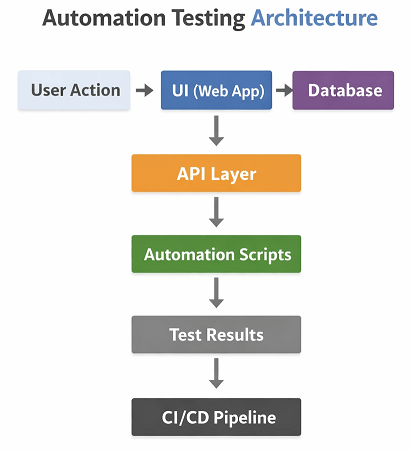
Unlike earlier roles, automation testers are now deeply involved in the development lifecycle. They contribute to test strategy, review code, and ensure fast feedback through continuous testing.
In simple terms, an automation tester today works as a quality engineer who combines coding, testing, and problem-solving skills to build reliable automation systems.
If you focus on only tools, you will struggle in interviews. If you focus on these core skill areas, you become job-ready faster:
- Technical skills for writing and maintaining automation scripts
- Testing knowledge to design effective test scenarios
- Tool expertise to work with modern automation frameworks
- DevOps and CI CD understanding for continuous testing
- Soft skills for collaboration and problem solving
In the next sections, we will break down each of these skills in detail with practical examples and real-world insights.
What Technical Skills Are Required for an Automation Tester?
The technical skills required for automation tester include programming, automation tools, API testing, version control, and CI CD knowledge. These skills help you build, run, and maintain automated test systems In actual work environments.
In modern software teams, automation testers are expected to write clean code, design frameworks, and integrate tests into development pipelines instead of just executing scripts.
Here are the most important technical skills you should focus on:
Why Programming Skills Are Essential for Automation Testing?
To get started, focus on these core programming fundamentals:
- Learn one language like Java, JavaScript, or Python
- Understand loops, conditions, and functions
- Learn object oriented programming basics
- Work with collections like arrays and lists
Quick tip: JavaScript is widely used with Playwright, while Java is common in Selenium-based enterprise projects.
Which Automation Tools Should You Learn First?
Here are the most important automation tools you should start with:
- Playwright for modern automation (see our complete Playwright tutorial)
- Selenium for legacy and enterprise systems
- Cypress for frontend-focused testing
According to Playwright documentation, it supports Chromium, WebKit, and Firefox with built-in auto-waiting, which helps reduce flaky tests.
Why API Testing Is a Must-Have Skill?
API testing allows you to validate backend functionality without relying on UI, making tests faster and more reliable.
Focus on these key API testing fundamentals:
- Understand REST APIs and HTTP methods
- Use tools like Postman
- Validate status codes, headers, and responses
How Version Control Helps Automation Testers?
Version control systems like Git help you manage code changes and collaborate with teams.
Here are the essential Git concepts every automation tester should know:
- Learn Git basics like commit, push, and pull
- Understand branching and merging
- Use GitHub or GitLab for collaboration
What Is the Role of CI CD in Automation Testing?
CI CD pipelines automatically run your tests whenever code changes are made, ensuring fast feedback and continuous quality.
In practice, this involves:
- Use Jenkins, GitHub Actions, or GitLab CI
- Run tests on every commit
- Generate reports automatically
Why Debugging Skills Matter in Automation?
Debugging helps you identify why a test fails and fix issues quickly. This is one of the most important real-world skills.
In real-world scenarios, many automation challenges and solutions are actively discussed by developers on platforms like Stack Overflow automation testing discussions, where you can explore practical debugging problems and solutions.
To debug effectively, focus on these techniques:
- Read logs and error messages
- Use breakpoints and step execution
- Analyze network and console logs
Real-world insight: Writing test scripts is easy. Fixing failing tests is where real skill is required.
What this means is: Technical skills help you build automation, but your ability to debug, structure, and scale those tests is what makes you job-ready.
In real automation projects, I have seen that writing test scripts is only a small part of the job. Most of the effort goes into debugging failures, handling flaky tests, and maintaining stable frameworks. This is why companies prioritize problem-solving skills over tool knowledge.
What Non-Technical Skills Are Required for an Automation Tester?
Non-technical skills are equally important as technical skills for an automation tester. These skills help you collaborate with teams, understand requirements clearly, and build practical automation solutions that actually solve real problems.
In many real-world projects, communication and thinking ability matter more than just writing code. This is where many technically strong testers still struggle.
Here are the key non-technical skills you should develop:
Why Is Analytical Thinking Important in Automation Testing?
Analytical thinking helps you break down complex features into testable scenarios. Automation is not about testing everything. It is about testing the right things efficiently.
This includes:
- Identify critical test scenarios
- Understand edge cases and failure conditions
- Prioritize what should be automated
Simply put, good testers think before they automate.
How Communication Skills Impact Automation Testing?
Clear communication ensures that you understand requirements correctly and report issues effectively. Automation testers work closely with developers, product managers, and QA teams.
Strong communication involves:
- Explain bugs clearly with steps and logs
- Discuss automation strategy with team
- Write clean and understandable test cases
Real-world tip: A well-explained bug saves hours of back and forth communication.
Why Problem-Solving Skills Are Critical?
Automation testing is full of unexpected issues such as flaky tests, environment failures, and timing problems. Problem-solving skills help you handle these situations efficiently.
In real scenarios, this means:
- Debug failing test cases logically
- Find root cause instead of quick fixes
- Handle dynamic elements and timing issues
This is the difference between someone who writes scripts and someone who builds stable automation.
What Role Does Attention to Detail Play?
Attention to detail helps you catch small issues that can break test scripts or miss critical bugs. Even a minor locator change can cause failures.
Key areas to focus on include:
- Write precise locators
- Validate exact expected results
- Avoid false positives and false negatives
Small mistakes in automation can lead to big issues in production.
Why Adaptability Is a Must-Have Skill?
Automation tools and technologies change rapidly. What is popular today may become outdated in a few years.
To stay relevant, you should:
- Learn new tools like Playwright and Cypress
- Stay updated with testing trends
- Be open to switching technologies
The key idea is that continuous learning is part of the job.
How Time Management Affects Automation Projects?
Automation tasks often involve multiple responsibilities like writing scripts, fixing failures, and maintaining frameworks. Time management helps you stay productive.
Effective time management includes:
- Balance manual and automation work
- Meet sprint deadlines
- Avoid over-automation of low-value tests
Important note: Not everything should be automated. Choosing what NOT to automate is also a skill.
Which Tools and Technologies Should an Automation Tester Learn?
An automation tester should learn tools and technologies that help build, execute, and maintain automated tests efficiently. Currently, the focus is on modern frameworks, cross-browser testing, API automation, and CI CD integration.
Most beginners waste time jumping between tools. What actually matters is understanding how these tools fit together in a real project.
Here is a complete overview of the tools and technologies you should focus on:
What Are the Most Popular Automation Testing Tools?
Automation testing tools allow you to interact with web applications, simulate user actions, and validate outcomes automatically.
| Tool | Best For | Why It Matters |
|---|---|---|
| Playwright | Modern web automation | Fast, reliable, supports multiple browsers |
| Selenium | Enterprise automation | Widely used, strong community support |
| Cypress | Frontend testing | Easy setup, great for UI testing |
Current best practice: Many teams are shifting from Selenium to Playwright due to better stability and built-in features.
Not sure whether to choose Playwright or Selenium for automation testing? Read this complete Playwright vs Selenium comparison to understand key differences, pros, and when to use each tool.
Which Test Frameworks Should You Understand?
Test frameworks help organize your test scripts, manage execution, and generate reports. Without a framework, your automation becomes hard to maintain.
- TestNG or JUnit for Java-based projects
- Playwright Test for JavaScript and TypeScript
- PyTest for Python automation
Framework knowledge helps you scale automation in real projects instead of writing isolated scripts.
Why API Testing Tools Are Important?
API testing tools help validate backend functionality without relying on UI. This improves speed and reliability of testing.
- Postman for manual API testing
- Playwright API testing for automation
- REST Assured for Java-based API automation
Most bugs today are found at API level, so this skill gives you a strong advantage.
What Role Do CI CD Tools Play?
CI CD tools automate the execution of tests whenever code changes are made. This ensures faster feedback and better quality.
- Jenkins for traditional CI pipelines
- GitHub Actions for cloud-based workflows
- GitLab CI for integrated DevOps pipelines
In today’s teams, tests are expected to run automatically without manual intervention.
Which Version Control Systems Should You Use?
Version control systems help manage your code and collaborate with team members effectively.
- Git for version control
- GitHub and GitLab for repository management
Understanding branching strategies and pull requests is essential for team collaboration.
What Supporting Tools Improve Automation Efficiency?
Supporting tools help with debugging, performance testing, and reporting, making your automation more powerful.
- Browser DevTools for debugging UI issues
- Allure or Extent Reports for test reporting
- Docker for environment consistency
- JMeter for performance testing basics
In practice, Knowing only one tool is not enough. Strong automation testers understand the complete ecosystem.
What Real-World Skills Do Automation Testers Need Today?
This is the part most tutorials skip, how automation actually works in real projects. Automation testers must build stable frameworks, handle flaky tests, and work within fast-paced development cycles.
In real projects, companies do not care how many scripts you write. They care whether your automation actually catches bugs, reduces manual effort, and works reliably in CI pipelines.
Here are the practical skills that make a real difference in the industry:
How to Design a Scalable Automation Framework?
A scalable automation framework allows you to add new test cases easily without breaking existing ones. This is a core expectation in real projects.
- Use Page Object Model or similar design patterns
- Separate test logic from test data
- Create reusable methods and utilities
- Maintain clean folder structure
In practice, Poor framework design leads to high maintenance cost and unstable tests.
Real Example: How Automation Works in a Real Project
Let’s say you are testing an e-commerce website.
In a real scenario, you would typically:
- Automate login and checkout flows using Playwright
- Validate payment APIs through API testing
- Run tests automatically using CI CD pipelines
- Debug failures using logs and screenshots
Now imagine the checkout test fails randomly.
A beginner might re-run the test or add delays.
An experienced automation tester will:
- Check network requests
- Verify API response timing
- Identify unstable UI elements
- Fix root cause instead of applying temporary fixes
This is what real automation work looks like in the industry.
Why Handling Flaky Tests Is a Critical Skill?
Flaky tests are one of the biggest frustrations in automation. These tests fail randomly even when nothing is broken.
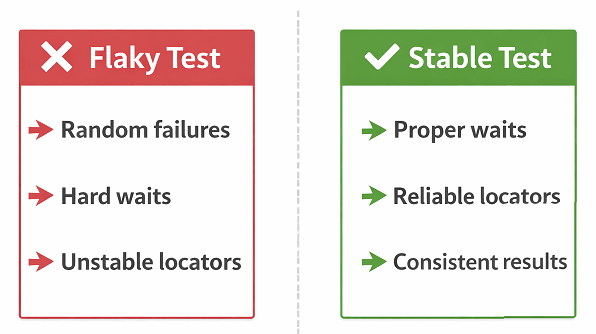
Tip: Understanding this concept helps you build more reliable and production-ready automation frameworks.
To reduce flaky tests:
- Use proper waits instead of hard waits
- Avoid unstable locators
- Handle dynamic elements carefully
- Reduce dependency on UI when possible
This is where tools like Playwright help with built-in auto waiting features.
What Does Debugging Failed Tests Involve?
Debugging is not just fixing errors. It involves identifying the root cause of failure across UI, API, or environment.
Debugging typically involves:
- Analyze logs and screenshots
- Check network requests and responses
- Validate test data and environment setup
- Reproduce issues locally
Here is where most beginners make mistakes: They fix symptoms instead of fixing the actual problem.
Why Understanding Application Architecture Matters?
Knowing how an application is built helps you write better test strategies. This includes frontend, backend, and database interactions.
Key concepts to understand include:
- Understand client-server architecture
- Know how APIs connect UI and backend
- Identify where to test (UI vs API vs unit level)
This helps you avoid unnecessary UI automation and improves efficiency.
How to Decide What Should Be Automated?
Not every test case should be automated. Choosing the right scenarios is a key skill.
As a general rule:
- Automate repetitive and high-risk scenarios
- Avoid one-time or rarely used flows
- Focus on critical business functionality
What this means is, smart automation is better than excessive automation.
What Are the Latest Industry Expectations from Automation Testers?
Today, companies expect automation testers to go beyond traditional roles and contribute to overall product quality.
In modern teams, this means:
- Work in Agile and Scrum environments
- Collaborate with developers and DevOps teams
- Participate in code reviews and test planning
- Ensure faster feedback through continuous testing
Here’s the reality: Automation testers who understand the full development cycle grow faster in their careers.
What Most Automation Testing Tutorials Don’t Tell You About Real Projects
Most tutorials focus heavily on tools and syntax, but that is not what makes someone successful in automation testing.
Here are a few truths that experienced testers learn the hard way:
- Tools matter, but problem-solving matters more: You can learn any tool in a few weeks, but debugging real failures takes months of practice.
- UI automation is often overused: Many beginners try to automate everything through UI, while experienced testers prefer API-level testing for speed and stability.
- Flaky tests are a bigger challenge than writing tests: Anyone can write scripts, but maintaining stable automation is where real expertise shows.
- Framework design matters more than number of test cases: A clean structure saves hundreds of hours in the long run.
- Most interview questions are based on real problems, not theory: Companies care about how you think, not what definitions you remember.
The key idea: Focus on thinking like an engineer, not just learning tools.
What Common Mistakes Should Automation Testers Avoid?
Automation testers often make mistakes that reduce test reliability and increase maintenance effort. Avoiding these mistakes can save time and improve the effectiveness of your automation.
Here are the most common mistakes beginners and even experienced testers make:
- Over-automation: Trying to automate everything instead of focusing on high-value test cases
- Using unstable locators: Leads to flaky and frequently failing tests
- Ignoring API testing: Relying only on UI tests slows down execution
- No proper framework structure: Makes tests hard to maintain
- Not handling waits correctly: Causes timing issues and false failures
- Skipping debugging: Fixing symptoms instead of root causes
Important note: The biggest mistake is treating automation as a one-time task. In reality, automation requires continuous maintenance and improvement.
Bottom line: Stable automation is not about writing more tests. It is about writing the right tests in the right way.
Technical vs Non-Technical Skills for Automation Testers
Automation testers need a balanced combination of technical and non-technical skills. Technical skills help you build automation, while non-technical skills help you apply it effectively in real-world scenarios.
| Skill Type | Examples | Why It Matters |
|---|---|---|
| Technical Skills | Programming, Playwright, API Testing, CI CD | Used to build and execute automation scripts |
| Non-Technical Skills | Communication, Problem Solving, Analytical Thinking | Helps in understanding requirements and debugging issues |
| Real-World Skills | Framework Design, Handling Flaky Tests, Debugging | Ensures automation works reliably in production |
In short: Technical skills get you started, but real-world and soft skills help you grow in your career.
Which Skills Should You Learn First (Priority Guide)
Not all automation testing skills need to be learned at once. The key is to focus on high-impact skills first and build a strong foundation step by step.
The roadmap below shows the correct order to learn automation testing skills based on real-world industry requirements.
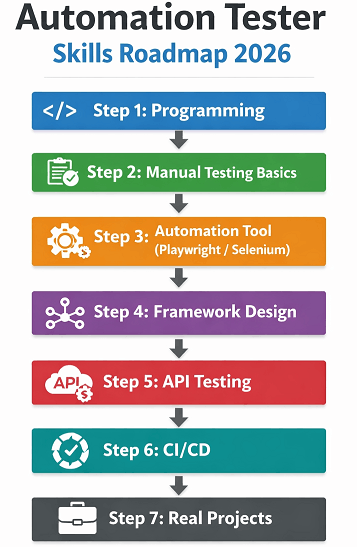
Recommended: Follow this roadmap step by step to become a job-ready automation tester faster.
Quick insight: Programming, automation tools, and API testing should be your top priority if you want faster career growth.
In addition to the roadmap, here is a priority breakdown of the most important skills and why they matter:
| Skill | Priority | Why It Matters |
|---|---|---|
| Programming | High | Foundation of all automation work |
| Automation Tools | High | Used to implement test scripts |
| API Testing | High | Faster and more reliable than UI testing |
| Framework Design | Medium | Helps scale automation projects |
| CI CD | Medium | Enables continuous testing |
| Performance Testing | Low | Useful but not required for beginners |
Tip: Focus on high-priority skills first instead of trying to learn everything at once.
How to Become an Automation Tester in 2026 (Step-by-Step Roadmap)
If you are starting from scratch, following a structured roadmap will help you learn faster and avoid confusion.
To become an automation tester in 2026, follow these steps:
- Learn Basic Programming
- Start with Java, JavaScript, or Python
- Understand core concepts like loops, functions, and OOP
- Understand Manual Testing Fundamentals
- Learn test cases, test scenarios, and bug lifecycle
- Understand SDLC and STLC
- Start with an Automation Tool
- Learn Playwright or Selenium
- Write basic test scripts
- Learn Framework Design
- Understand Page Object Model
- Structure your automation project properly
- Learn API Testing
- Use Postman or automation tools
- Understand REST APIs
- Work with Git and CI CD
- Push your code to GitHub
- Run tests using CI tools like Jenkins
- Build Real Projects
- Create automation for real websites
- Handle dynamic elements and failures
- Prepare for Interviews
- Practice coding basics
- Understand real-world scenarios
Ask yourself: Can you debug a failing test without help? If not, that’s the skill you should focus on next.
Quick tip: Building 2 to 3 strong real-world projects is more valuable than completing multiple courses.
The main difference between automation testers and manual testers is that automation testers use scripts and tools to automate testing, while manual testers execute test cases manually without automation.
| Aspect | Automation Tester | Manual Tester |
|---|---|---|
| Execution | Automated scripts | Manual testing |
| Speed | Fast | Slow |
| Skills | Programming required | No coding required |
| Best For | Regression, large systems | Exploratory testing |
Is Automation Testing Hard to Learn?
Automation testing is not hard to learn if you follow a structured approach, but it can feel challenging at the beginning due to programming and debugging requirements.
For beginners, the difficulty usually comes from learning coding concepts and understanding how automation tools work in real projects. However, once you understand the basics, it becomes much easier to progress.
Here is what makes automation testing easier:
- Starting with one programming language instead of multiple
- Learning one tool like Playwright or Selenium step by step
- Practicing with real-world examples instead of only theory
- Understanding debugging early instead of avoiding it
In simple terms: Automation testing is not difficult, but it requires consistent practice and problem-solving skills.
Conclusion
Automation testing in 2026 is no longer just about tools or scripts. It’s about thinking like an engineer, solving problems, building reliable systems, and continuously improving your approach.
If you focus only on tools, your growth will be slow. But if you build strong fundamentals, real project experience, and debugging skills, you will stand out quickly.
Start small, build real projects, and focus on skills that actually matter in the industry. That is what turns a beginner into a job-ready automation tester.
FAQs
What are the most important skills required for automation tester?
The most important skills for an automation tester are programming, testing fundamentals, API testing, and debugging. These skills help build reliable and scalable automated test systems.
Is coding mandatory for automation testing?
Yes, coding is essential for automation testing. You need at least one programming language such as Java, JavaScript, or Python to write and maintain automation scripts.
Which programming language is best for automation testing?
Java, JavaScript, and Python are the most popular languages. JavaScript is widely used with Playwright, while Java is commonly used with Selenium in enterprise projects.
Can a manual tester become an automation tester?
Yes, a manual tester can become an automation tester by learning programming, automation tools, and frameworks. Understanding testing fundamentals gives a strong advantage.
Do automation testers need to learn API testing?
Yes, API testing is a critical skill because many modern applications rely on backend services. It helps testers validate functionality faster than UI testing.
What tools should an automation tester learn today?
Automation testers should learn Playwright, Selenium, API testing tools like Postman, version control like Git, and CI CD tools such as Jenkins or GitHub Actions.
How long does it take to learn automation testing?
It typically takes 3 to 6 months to learn automation testing basics and 6 to 12 months to become job-ready, depending on practice and project experience.
Is automation testing a good career in 2026?
Yes, automation testing is a high-demand career today due to increasing focus on software quality, faster releases, and continuous integration practices.