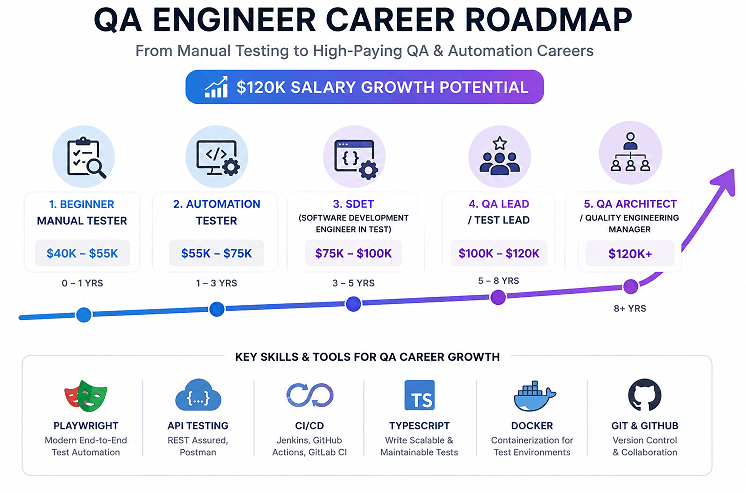
This QA Career Roadmap can realistically take professionals from entry-level testing roles to $120K+ Automation QA or SDET positions with the right technical skills, automation expertise, and practical project experience. In 2026, companies increasingly pay higher salaries to QA Engineers who understand Playwright, Selenium, API testing, CI/CD pipelines, and modern software testing workflows.
The QA Career Roadmap explains what beginners should learn first, how long each stage usually takes, which skills increase salary the fastest, and how professionals move from manual testing into higher-paying automation and quality engineering roles.
Whether you are a fresher, career switcher, manual tester, or aspiring automation engineer, this guide covers the full software testing career path from beginner fundamentals to senior QA, SDET, and test architecture roles.
- What Is the QA Career Roadmap in 2026?
- How to Become a QA Engineer in 2026
- How Much Can You Earn in a QA Career?
- Step-by-Step QA Career Roadmap From Beginner to $120K
- Which Skills Increase QA Engineer Salary the Fastest?
- What Are the Biggest Mistakes That Slow Down QA Career Growth?
- How to Reach a $120K QA Salary Faster
- What Is the Future of QA Careers in 2026 and Beyond?
- QA Career Roadmap Timeline for Beginners
- How to Prepare for Your First QA Job
- Common Interview Questions in a QA Career Path
- Best Learning Strategy for Beginners Entering QA
- QA Career Roadmap for Different Backgrounds
- Remote QA Jobs and Global Career Opportunities
- Daily Learning Plan for Beginners Starting a QA Career
- Best Resources to Learn QA and Test automation
- Advanced QA Career Paths Beyond Automation Testing
- What Companies Look for When Hiring QA Engineers
- Conclusion
- QA Career Roadmap FAQs for Beginners
What Is the QA Career Roadmap in 2026?
A QA Career Roadmap is a step-by-step path that helps beginners grow from manual testing into automation testing, SDET, QA leadership, or test architecture roles by learning software testing fundamentals, programming, automation tools, API testing, and CI/CD workflows.
In simple terms, the quality engineering career path starts with understanding how software testing works. After building strong manual testing fundamentals, most professionals move into automation testing because automation skills significantly increase salary opportunities and job demand.
Modern software teams no longer hire testers only for repetitive manual validation and bug reporting. Businesses now expect QA professionals to understand automation frameworks, browser testing, APIs, cloud platforms, and release pipelines.
That is why tools like Playwright, Selenium, Cypress, Postman, Jenkins, GitHub Actions, and Docker are becoming important in software tester career growth.
Typical QA Career Path
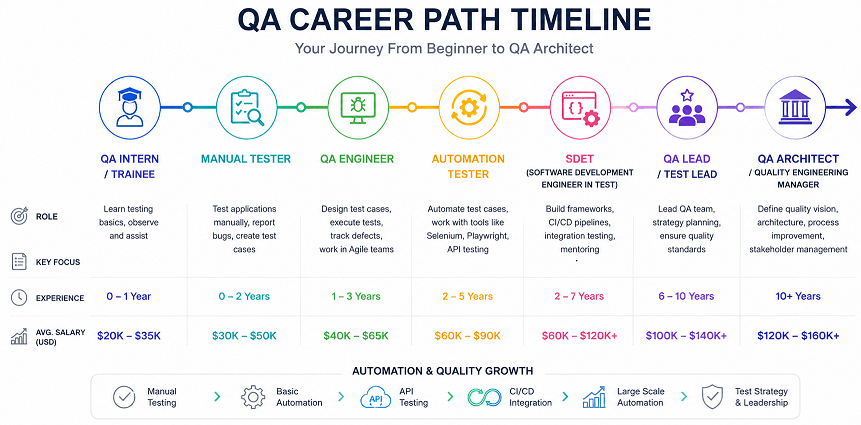
- QA Intern or Trainee
- Manual QA Tester
- QA Engineer
- Automation Test Engineer
- SDET (Software Development Engineer in Test)
- Senior Software Testing Engineer
- QA Lead or Test Architect
One of the most common questions beginners ask is whether QA can realistically become a high-income career. The answer is yes. However, higher salaries usually come from automation testing, programming knowledge, framework development, and solving complex testing problems instead of only manual execution work.
The strongest income growth usually comes from combining testing knowledge with automation and engineering skills.
After understanding the overall roadmap, the next important question is how QA salaries actually grow at different career stages.
How to Become a QA Engineer in 2026
Most beginners enter the QA industry by first learning manual testing fundamentals and then gradually moving into automation and quality engineering skills. The fastest way to become a QA Engineer is usually through project-based learning instead of only watching tutorials or collecting certifications.
A practical beginner roadmap often looks like this:
- Learn software testing fundamentals
- Practice manual testing on real websites
- Learn basic programming
- Start automation testing with Playwright or Selenium
- Learn API testing and Git
- Build automation projects on GitHub
- Prepare for QA interviews and real-world workflows
Beginners who consistently practice testing and automation for a few months often become ready for junior QA or automation testing roles faster than learners who only focus on theory.
How Much Can You Earn in a QA Career?
A QA career can start with entry-level salaries around $25K to $45K depending on country, skills, and company type. However, experienced Automation Test Engineers and SDETs often earn between $90K and $120K+ after building strong technical expertise.
Salary growth in QA usually depends on three major factors: automation skills, programming knowledge, and experience working on real projects. Professionals who stay only in manual QA work for many years often see slower pay progression compared to engineers who move into automation and modern testing tools.
| QA Career Stage | Typical Experience | Estimated Salary Range |
|---|---|---|
| QA Intern / Fresher | 0 to 1 Year | $20K to $40K |
| Manual testing professional | 1 to 3 Years | $35K to $60K |
| Automation QA professional | 2 to 5 Years | $60K to $90K |
| SDET / Senior Automation Engineer | 5 to 8 Years | $90K to $120K+ |
| QA Lead / Test Architect | 8+ Years | $110K to $150K+ |
QA salaries usually increase when professionals move from repetitive manual testing into automation engineering, API testing, framework development, and CI/CD integration. Engineers who can improve automation scalability and reduce release bottlenecks are typically paid significantly more than manual-only testers.
Remote jobs also changed QA salary trends. Many skilled quality engineers now work remotely for international companies while living in lower-cost countries. Because of this, automation testing and Playwright testing skills have become highly valuable in the global market.
Is QA Engineering Still a Good Career in 2026?
Yes. QA Engineering remains a strong career because software companies still need reliable testing, faster releases, and automated quality checks. AI tools can assist testing workflows, but companies still need skilled test engineers who understand real user behavior, automation strategy, debugging, and product quality.
Which QA Roles Usually Pay the Highest Salaries?
- SDET roles
- Playwright Automation Engineers
- Performance Test Engineers
- Security Test Engineers
- QA Architects
- DevOps-focused software testers
In short, QA salaries increase fastest when testing skills are combined with coding, automation frameworks, APIs, and CI/CD knowledge.
Step-by-Step QA Career Roadmap From Beginner to $120K
The best way to build a successful QA career is to learn skills in the correct order. A lot of newcomers spend too much time switching between tutorials, tools, and courses without building practical skills that companies actually look for during hiring.
This software QA path focuses on practical growth. Each stage builds on the previous one and prepares you for higher-paying roles in automation testing and software quality engineering.
Step 1: Learn Software Testing Fundamentals
Every QA Engineer should first understand the basics of software testing before touching automation tools. Strong fundamentals help you identify bugs, understand product behavior, and write better test cases.
- SDLC and STLC basics
- Bug lifecycle
- Test cases and test scenarios
- Functional and non-functional testing
- Regression testing
- Smoke and sanity testing
- Agile and Scrum basics
Beginners who skip testing fundamentals often struggle later in automation projects because they know tools but not actual testing logic.
Step 2: Start Manual Testing on Real Projects
Manual testing helps beginners understand how real applications behave. At this stage, focus on thinking like an end user instead of memorizing definitions.
Practice testing real websites, eCommerce flows, forms, login systems, dashboards, and APIs. This builds observation skills and helps you understand how bugs impact users.
Step 3: Learn Basic Programming
Programming becomes important when moving into automation testing because modern frameworks rely heavily on coding. You do not need advanced software engineering expertise, but understanding coding fundamentals is necessary for building reliable automation tests.
Most QA professionals learn one of these languages:
- JavaScript
- TypeScript
- Java
- Python
- C#
TypeScript and JavaScript are growing rapidly because modern tools like Playwright use them heavily in automation testing. Beginners who want to build modern browser automation frameworks can start with the Playwright JavaScript Tutorial or the Playwright TypeScript Tutorial depending on their preferred language.
Step 4: Learn Automation Testing
Automation testing is usually the biggest salary turning point in a QA career. Organizations usually offer better salaries to professionals who can automate repetitive validation workflows and improve release reliability.
Many professionals use automation testing as the transition point from manual QA roles into higher-paying automation tester and SDET career paths.
Important automation tools include:
- Playwright
- Selenium
- Cypress
- Appium
Playwright is becoming one of the fastest-growing automation frameworks because it supports reliable browser automation, parallel execution, API testing, and modern web application workflows.
Beginners comparing modern and traditional automation tools can also read Playwright vs Selenium 2026: Which is Faster and Better?.
Step 5: Learn API Testing
Modern applications depend heavily on APIs, which makes API testing one of the most valuable technical QA skills. API validation helps teams detect backend issues earlier and test application behavior faster than relying only on UI testing.
Learn:
- HTTP methods
- Status codes
- JSON
- REST APIs
- Postman
- API automation
Step 6: Learn Git and CI/CD Basics
Many beginners ignore DevOps-related skills, but companies increasingly expect QA Engineers to work inside CI/CD pipelines.
Understanding modern CI/CD practices from industry-standard resources can help QA Engineers integrate automated testing into real deployment workflows more effectively.
Important tools and concepts include:
- Git and GitHub
- GitHub Actions
- Jenkins
- Docker basics
- Pipeline execution
- Test reporting
These skills make QA Engineers more valuable because they can integrate automation directly into deployment workflows.
Step 7: Build Real QA Projects
In many QA interviews, candidates are judged more by project quality than by certifications alone. Interviewers often pay close attention to framework structure, debugging approach, test organization, and whether the project solves realistic testing problems.
Create projects such as:
- Playwright automation framework
- API testing framework
- Cross-browser testing project
- CI/CD integrated automation suite
- Data-driven testing framework
Upload projects to GitHub and write documentation clearly. Recruiters and hiring managers often check project quality before interviews.
Hiring managers often care more about how candidates explain debugging decisions, framework structure, and testing strategy than how many certificates they completed.
Step 8: Specialize for Higher Salaries
After gaining experience, specialization becomes one of the fastest ways to increase salary.
High-paying QA specializations include:
- SDET engineering
- Performance testing
- Security testing
- Cloud testing
- Mobile automation
- AI testing
- Test architecture
Simply put, general QA skills help you enter the industry, but specialization usually helps you reach senior salary levels faster.
Salary growth becomes much easier to understand once you know which skills companies actually value the most.
Which Skills Increase QA Engineer Salary the Fastest?
Income growth becomes much stronger when software testing skills are combined with coding, automation frameworks, and modern engineering workflows. Companies pay more to QA Engineers who can solve technical problems, improve release quality, and reduce manual test execution effort.
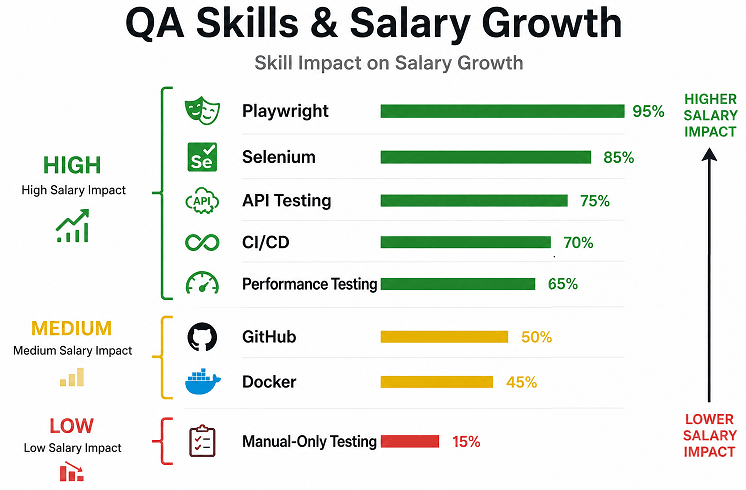
In 2026, automation-focused QA roles continue to grow much faster than traditional manual-only testing roles. Engineers who learn modern testing tools and development workflows usually unlock better remote jobs, stronger career growth, and higher salary opportunities.
| Skill | Why It Matters | Salary Impact |
|---|---|---|
| Playwright | Modern browser automation and end-to-end testing | Very High |
| Selenium | Widely used enterprise automation framework | High |
| TypeScript / JavaScript | Required for modern automation frameworks | Very High |
| API Testing | Faster backend validation and integration testing | High |
| CI/CD | Automated testing inside deployment pipelines | High |
| Git and GitHub | Version control and collaboration | Medium to High |
| Docker | Consistent test environments and scalability | Medium to High |
| Performance Testing | System scalability and load validation | Very High |
| Cloud Testing | Testing cloud-native applications | High |
Professionals planning long-term automation careers should also understand which technical skills companies actively hire for today. This detailed guide on Skills Required for Automation Tester in 2026 explains the most valuable tools, programming languages, and testing skills for higher-paying roles.
Why Playwright Skills Are Becoming Valuable
Playwright is growing rapidly because modern applications require reliable cross-browser automation, fast execution, and stable testing. Many companies are moving from older Selenium-based frameworks to Playwright because of better stability and developer experience.
Many QA teams also compare Playwright with Puppeteer when evaluating modern browser automation frameworks because both tools support fast headless testing and JavaScript-based workflows.
Candidates with Playwright, TypeScript, API testing, and CI/CD experience often stand out during hiring because those skills align closely with modern engineering workflows.
Does Programming Knowledge Really Matter in QA?
Yes. Programming knowledge is now one of the biggest salary differentiators in testing profession. Engineers who can write maintainable automation frameworks usually earn much more than testers who only execute manual test cases.
You do not need advanced computer science expertise to start. However, understanding variables, functions, loops, conditions, arrays, asynchronous operations, and object-oriented concepts becomes important for test automation.
Which Soft Skills Help QA Engineers Grow Faster?
Technical skills are important, but communication and problem-solving also strongly affect career growth.
- Bug reporting clarity
- Analytical thinking
- Communication skills
- Team collaboration
- Attention to detail
- Requirement analysis
- Prioritization skills
Many senior QA Engineers earn leadership roles because they can explain quality risks clearly to developers, managers, and business teams.
Should Beginners Learn Manual Testing or Automation First?
Beginners should first understand manual software testing fundamentals before moving into automation. Automation tools become much easier to learn when you already understand test design, application behavior, bug analysis, and user workflows.
In short, strong testing fundamentals plus automation skills create the best long-term software testing profession growth.
Along with learning the right skills, avoiding career mistakes is equally important for long-term growth.
What Are the Biggest Mistakes That Slow Down QA Career Growth?
Many QA Engineers work hard for years but still struggle to increase salary or move into better roles. In most cases, the problem is not lack of effort. The real issue is learning outdated skills, avoiding technical growth, or staying too comfortable in repetitive manual testing work.
Understanding these career mistakes early can help beginners avoid years of slow salary growth.
1. Staying Only in Manual Testing for Too Long
Manual QA work is important for learning fundamentals, but staying only in manual execution for many years can limit salary growth. Modern companies increasingly prefer QA Engineers who can automate testing workflows.
Many higher-paying testing roles now expect at least foundational automation skills.
2. Learning Tools Without Understanding Testing
A common learning mistake is jumping directly into Playwright, Selenium, or Cypress tutorials before understanding how testing actually works in real software projects. This often creates engineers who know syntax but struggle with real-world problem solving.
Companies hire QA Engineers to improve product quality, not only to write scripts.
3. Ignoring API Testing
API testing is one of the most underrated skills in QA careers. Many applications depend heavily on APIs, and backend issues are often easier to identify through API validation than through UI testing alone.
QA Engineers who know API testing usually become more efficient and technically stronger.
4. Avoiding Programming Fundamentals
Some testers try to avoid coding completely. That approach becomes risky in modern QA careers because automation, CI/CD, and framework customization all require programming knowledge.
You do not need advanced development expertise, but basic coding confidence is now essential.
5. Building No Real Projects
Certificates alone rarely impress experienced interviewers. Well-built projects show how you structure automation, handle failures, organize reusable code, and solve practical testing challenges under realistic conditions.
A small but properly structured GitHub project with clean documentation, reusable utilities, reporting, and CI/CD integration can leave a much stronger impression than multiple unfinished tutorial projects.
6. Ignoring Communication Skills
Testing professionals regularly collaborate with developers, product managers, designers, and business stakeholders. Weak communication can slow career growth even when technical skills are strong.
Clear bug reports and strong collaboration often separate senior engineers from junior engineers.
7. Depending Only on One Tool
Technology changes quickly in software testing. Engineers who depend entirely on one framework or tool may struggle when market demand shifts.
It is safer to understand testing principles deeply while staying flexible with tools.
After understanding common career mistakes, the next step is learning how experienced professionals accelerate salary growth strategically.
How to Reach a $120K QA Salary Faster
Reaching high QA salaries usually requires a combination of technical growth, project experience, and smart career positioning. Most engineers do not reach senior salary levels by simply waiting for yearly increments.
Focus on High-Value Technical Skills
- Playwright automation
- TypeScript or JavaScript
- API automation
- CI/CD pipelines
- Docker basics
- Cloud testing
- Performance testing
Professionals planning international remote careers can also review the Automation Tester Salary in USA 2026 guide to understand which automation skills currently influence salary growth the most.
Work on Real Business Scenarios
Employers value engineers who can solve real testing problems. Practice testing checkout flows, authentication systems, dashboards, reporting modules, and payment workflows instead of only simple demo applications.
Build a Strong GitHub Portfolio
A strong GitHub profile can improve interview chances, especially for remote automation roles. Include proper project structure, documentation, reporting, reusable utilities, and CI/CD integration.
Learn How Modern Teams Actually Work
Many beginners focus only on writing tests but ignore how software teams operate. Understanding Agile workflows, pull requests, release pipelines, code reviews, and sprint processes helps QA Engineers grow faster inside companies.
Improve Interview Communication
Technical skills alone are often not enough for senior positions. Senior QA Engineers usually explain problems clearly, discuss trade-offs confidently, and communicate testing strategies effectively.
Stay Updated With Industry Changes
The testing industry changes rapidly. AI-assisted testing, cloud environments, modern browser frameworks, and shift-left testing are already reshaping QA workflows.
Many professionals also research salary trends before choosing a specialization path. These guides on Automation Tester Salary in USA 2026 and QA Engineer Salary UK 2026 explain how salaries grow across different regions and experience levels.
Professionals who continuously adapt to changing tools and workflows usually experience stronger long-term career growth.
Simply put, the fastest-growing career in software testing belong to engineers who combine technical depth, practical experience, communication skills, and continuous learning.
What Is the Future of QA Careers in 2026 and Beyond?
The future of QA careers remains strong because software companies continue shipping updates rapidly and need reliable testing systems to maintain software quality. Businesses still need skilled QA Engineers to maintain product quality, reduce production bugs, and improve user experience across web, mobile, cloud, and API platforms.
However, the role of test engineers is evolving quickly. Traditional manual-only testing roles are shrinking, while automation-focused and engineering-focused QA roles continue growing.
Will AI Replace QA Engineers?
No. AI tools can assist QA workflows, but AI cannot fully replace experienced quality engineers. Modern testing involves critical thinking, exploratory testing, business understanding, risk analysis, and real user behavior validation.
AI tools can generate test ideas, automate repetitive tasks, and speed up debugging. Still, companies need QA professionals who can design testing strategies, identify edge cases, and make quality decisions.
In many teams, AI is becoming a productivity tool for QA Engineers rather than a replacement.
Why Automation Testing Demand Keeps Growing
Software teams now release features continuously through CI/CD pipelines. Manual-only testing often becomes too slow for modern development speed.
Because of this, companies increasingly invest in:
- End-to-end automation
- API automation
- Parallel test execution
- Cloud-based testing
- Cross-browser automation
- AI-assisted testing workflows
Frameworks like Playwright are growing rapidly because they support modern browser automation and faster testing execution.
Which QA Roles Will Have the Highest Demand?
| QA Role | Future Demand | Growth Potential |
|---|---|---|
| Automation QA Engineer | Very High | Strong |
| SDET | Very High | Excellent |
| Performance Test Engineer | High | Strong |
| Security Test Engineer | High | Strong |
| Cloud testing professional | High | Excellent |
| Manual Tester | Moderate | Limited |
Is QA Still a Good Career for Beginners?
Yes. QA remains one of the most accessible entry points into the software industry because beginners can start learning testing fundamentals without deep development experience.
At the same time, the career still offers strong long-term growth for engineers willing to learn automation, APIs, CI/CD, and programming fundamentals.
What Will Successful QA Engineers Look Like in the Future?
The most successful software testers in the coming years will likely combine multiple skill areas instead of focusing only on manual execution.
- Testing fundamentals
- Automation engineering
- Programming knowledge
- API testing
- Cloud and DevOps basics
- AI-assisted testing workflows
- Business understanding
Future QA roles will increasingly reward engineers who contribute to product quality, automation strategy, and engineering workflows instead of only executing manual tests.
Once the long-term future looks clear, beginners usually want to understand how quickly they can realistically become job-ready.
QA Career Roadmap Timeline for Beginners
Learning speed depends on consistency, project work, and prior technical background. Some beginners move into junior automation roles within months, while others take longer depending on learning approach and practical exposure.
| Career Stage | Estimated Learning Time | Main Focus |
|---|---|---|
| Testing Fundamentals | 1 to 2 Months | Manual test execution basics and QA concepts |
| Manual Testing Practice | 1 to 3 Months | Real-world testing scenarios |
| Programming Basics | 2 to 4 Months | JavaScript, TypeScript, Java, or Python |
| Automated testing | 3 to 6 Months | Playwright, Selenium, Cypress |
| API Testing and CI/CD | 2 to 4 Months | Postman, GitHub Actions, Jenkins |
| Advanced QA Engineering | Ongoing | Frameworks, scalability, architecture |
The timeline may look long, but consistent learning and project-based practice usually create much stronger career results than rushing through tutorials quickly.
Which automation tool is best for QA careers?
The QA Career Roadmap starts with manual QA work fundamentals and gradually moves into automation engineering, API testing, programming, CI/CD, and advanced QA engineering skills. Beginners often start as Manual Testers, then grow into Automation quality engineers, SDETs, Senior testing professional, or QA Architects.
Modern QA salaries increase significantly with automation and technical skills. Engineers who learn Playwright, Selenium, TypeScript, API automation, GitHub Actions, Docker, and cloud testing usually unlock better salary growth and remote job opportunities.
| QA Career Goal | Main Skills Required |
|---|---|
| Manual QA Tester | Testing fundamentals, bug reporting, Agile basics |
| Automation QA Engineer | Playwright, Selenium, JavaScript, API testing |
| SDET | Automation frameworks, CI/CD, advanced coding |
| QA Lead | Strategy, leadership, architecture, mentoring |
| QA Architect | Scalable frameworks, cloud testing, engineering design |
Best Skills to Learn for High QA Salaries
- Playwright automation
- TypeScript or JavaScript
- API testing
- CI/CD pipelines
- Git and GitHub
- Docker basics
- Cloud testing
- Performance testing
Most Important Advice for Beginners
Do not rush directly into automation frameworks without understanding testing fundamentals first. Strong manual testing knowledge helps automation engineers write better automation, identify edge cases, and understand real user workflows more effectively.
Consistent project-based learning usually creates better career growth than collecting many certificates without practical experience.
How to Prepare for Your First QA Job
Many beginners spend months learning testing tools but still struggle to get interview calls because they do not prepare their profile properly. In most entry-level QA hiring, presentation of skills matters almost as much as the skills themselves.
Build a Small but Realistic Project Portfolio
Instead of creating dozens of unfinished practice projects, focus on building two or three realistic testing projects with proper structure and documentation.
Good beginner projects may include:
- Login and authentication testing
- eCommerce checkout automation
- API validation framework
- Cross-browser Playwright testing
- CI/CD-integrated automation suite
Optimize Your GitHub Profile
Recruiters and interviewers often review GitHub profiles before scheduling technical rounds. A clean GitHub profile can immediately improve credibility.
Make sure your repositories include:
- Clear README documentation
- Project setup steps
- Reusable framework structure
- Meaningful commit history
- Proper folder organization
Create a Strong QA Resume
Many beginner resumes focus too heavily on course completion instead of practical work. Employers usually care more about projects, tools used, debugging experience, and testing exposure.
Highlight skills such as:
- Playwright or Selenium
- API testing
- Git and GitHub
- CI/CD basics
- Bug reporting
- Automation frameworks
Practice Explaining Projects Clearly
Many candidates build projects but struggle to explain them confidently during interviews. Practice describing why you designed the framework a certain way, how you handled failures, and what testing challenges you solved.
Strong communication often creates a better impression than memorizing theoretical answers.
Common Interview Questions in a QA Career Path
QA interviews usually test both testing knowledge and practical problem-solving ability. Beginners are often asked about manual software testing concepts, while automation-focused roles include programming, framework design, API testing, and CI/CD questions.
Preparing for interviews early helps QA Engineers understand which skills companies actually value in real projects.
Manual Testing Interview Questions
- What is the difference between severity and priority?
- How do you write effective test cases?
- What is regression testing?
- Explain the bug lifecycle.
- What is smoke testing and sanity testing?
- How would you test a login page?
Automation Testing Interview Questions
- Why should companies use browser automation?
- What is the Page Object Model?
- How does Playwright differ from Selenium?
- What are flaky tests?
- How do you handle waits in automation?
- How do you structure automation frameworks?
API Testing Interview Questions
- What are HTTP methods?
- What is the difference between GET and POST?
- What are status codes?
- How do you validate API responses?
- What is authentication in APIs?
CI/CD and DevOps Questions
- What is CI/CD?
- How do automated tests run in pipelines?
- What is Jenkins?
- What is GitHub Actions?
- Why is Docker used in testing?
A large number of QA interviews now focus heavily on project discussions. Candidates who can clearly explain framework decisions, debugging challenges, flaky test handling, and automation architecture usually perform far better than candidates who only memorize theoretical answers.
Best Learning Strategy for Beginners Entering QA
One of the biggest mistakes beginners make is trying to learn everything at once. The QA field contains many tools, frameworks, and technologies, but successful learning usually happens step by step.
Focus on Fundamentals First
Before learning Playwright or Selenium, understand how testing actually works. Learn how bugs happen, how applications behave, and how users interact with software.
Build While Learning
Reading tutorials alone is rarely enough. Build small projects continuously while learning new concepts.
Examples include:
- Testing a login workflow
- Automating form submissions
- API validation projects
- Cross-browser testing setups
- CI/CD automation execution
Learn From Real Applications
Practice on realistic websites instead of only demo examples. Real-world applications expose you to timing issues, unstable locators, authentication flows, validations, and complex user behavior.
Document Your Learning Publicly
Writing blog posts, GitHub documentation, LinkedIn posts, or testing notes can strengthen understanding and improve visibility to recruiters.
Many software testers underestimate how much public learning helps career growth.
Avoid Tutorial Dependency
Some learners watch endless tutorials without building independent projects. Real growth usually starts when you begin solving problems without copying step-by-step solutions.
Stay Consistent Instead of Learning Randomly
Even one or two focused hours daily can produce strong long-term results. Consistency matters far more than short bursts of motivation.
Simply put, the strongest QA careers are usually built through steady practical learning over time.
QA Career Roadmap for Different Backgrounds
The QA field is one of the few software careers where people from many educational and professional backgrounds can successfully transition into technology. Many successful QA Engineers started as fresh graduates, support engineers, manual testers, freelancers, or even completely non-technical professionals.
The learning path may differ slightly depending on background, but the long-term growth opportunities remain strong for consistent learners.
QA Career Roadmap for Freshers
Freshers should first focus on software testing fundamentals, communication skills, and practical project work. Many companies hiring junior test engineers care more about practical understanding than advanced theoretical knowledge.
Recommended learning order:
- Software testing basics
- Manual test execution practice
- Bug reporting
- Basic programming
- automation testing workflows
- API testing
Freshers who build strong GitHub projects often stand out during hiring.
QA Career Roadmap for Manual Testers
Manual testers can significantly increase salary growth by moving into automation testing. The transition becomes easier when manual validation fundamentals are already strong.
The best upgrade path usually includes:
- JavaScript or TypeScript basics
- Playwright or Selenium
- API testing
- Git and GitHub
- CI/CD basics
Many experienced manual testers already understand product quality deeply. Adding automation skills often creates strong career acceleration.
QA Career Roadmap for Career Switchers
People switching from non-technical careers should focus first on understanding how software applications work. Testing is often easier to enter compared to many development roles because beginners can start with manual testing concepts.
However, long-term growth still requires technical learning and continuous skill improvement.
QA Career Roadmap for Developers Moving Into Testing
Developers moving into QA often adapt quickly to automation engineering because programming knowledge already exists. These professionals frequently move toward SDET, framework engineering, or test architecture roles.
The biggest learning area for developers is usually testing mindset and exploratory thinking rather than coding itself.
Remote QA Jobs and Global Career Opportunities
Remote hiring has expanded rapidly in software testing, especially for automation-focused positions. Many companies now hire internationally to find engineers with strong automation, API testing, and CI/CD experience.
Engineers with strong automation and communication skills can often work remotely for global teams while living in lower-cost regions.
Why Remote Companies Prefer Automation QA Engineers
Remote teams rely heavily on automated workflows, CI/CD pipelines, and scalable testing systems. Because of this, automation-focused QA professionals are often preferred for distributed teams.
Skills commonly expected in remote QA jobs include:
- Playwright or Selenium
- API automation
- Git workflows
- CI/CD integration
- Clear communication
- Independent problem solving
How to Improve Chances of Getting Remote QA Jobs
- Build strong GitHub projects
- Create a professional LinkedIn profile
- Write clear project documentation
- Practice interview communication
- Contribute to open-source testing projects
- Learn asynchronous team collaboration
Many remote employers value practical skills and project quality more than traditional degrees.
Do Remote QA Jobs Pay More?
In many cases, yes. Remote international companies often pay significantly higher salaries compared to local markets, especially for experienced automation engineers and SDETs.
However, competition is also stronger, so technical depth and communication quality become extremely important.
In short, remote work has created major opportunities for QA Engineers who continuously improve automation and engineering skills.
Learning timelines become easier to follow when supported by a structured daily routine and high-quality learning resources.
Daily Learning Plan for Beginners Starting a QA Career
Most people struggle in the beginning because their learning process becomes inconsistent and scattered across too many topics. A simple daily learning routine often produces better results than trying to study everything randomly.
The goal during the early months should be building practical understanding gradually instead of rushing through advanced topics too quickly.
Phase 1: First 30 Days
Focus completely on testing fundamentals and understanding how applications work.
- Learn SDLC and STLC basics
- Understand different testing types
- Practice writing test cases
- Learn bug reporting
- Test real websites manually
- Understand Agile workflows
Spend time observing user behavior and identifying possible edge cases. This builds the thinking process required for long-term QA growth.
Phase 2: Days 30 to 90
Start learning programming and automation basics.
- Learn JavaScript or TypeScript basics
- Understand variables, loops, functions, and conditions
- Start Playwright or Selenium
- Automate simple user flows
- Learn locators and waits
- Practice debugging automation failures
At this stage, small projects matter more than theoretical notes.
Phase 3: Days 90 to 180
Move into intermediate automation and real-world project building.
- Build framework structure
- Learn API testing with Postman
- Understand Git and GitHub
- Run tests in CI/CD pipelines
- Generate test reports
- Improve project documentation
Many beginners become interview-ready around this stage if learning remains consistent.
Recommended Daily Routine
| Activity | Suggested Daily Time |
|---|---|
| Learning theory | 30 to 45 Minutes |
| Hands-on practice | 1 to 2 Hours |
| Debugging and experimentation | 30 Minutes |
| Project building | 1 Hour |
| Documentation or revision | 15 to 30 Minutes |
Consistency is far more important than studying for very long hours occasionally.
Best Resources to Learn QA and Test automation
The internet contains thousands of testing tutorials, but not all resources are practical or beginner friendly. Learning from high-quality sources can save months of confusion.
Best Platforms for Learning QA
- Official Playwright documentation
- Selenium documentation
- Postman learning center
- GitHub repositories
- YouTube automation tutorials
- Real-world QA blogs
- Open-source testing projects
Why Official Documentation Matters
A large number of online tutorials become outdated within a short time, especially in fast-changing automation frameworks. Official documentation usually provides the most accurate and updated implementation details.
Engineers who learn how to read documentation early often become stronger problem solvers later.
Should Beginners Buy QA Courses?
Courses can help beginners follow a structured path, but practical project work remains more important than simply completing video lessons.
A beginner with strong projects and consistent practice often performs better in interviews than someone who completed many courses without hands-on implementation.
What Should You Practice Most?
- Writing test scenarios
- Debugging failed tests
- Locators and selectors
- API validation
- Framework structure
- CI/CD execution
- Cross-browser testing
Real career growth usually comes from solving practical testing problems repeatedly in real-world scenarios.
As software testing career grow, many professionals eventually move beyond standard automation testing into deeper specialization areas.
Advanced QA Career Paths Beyond Automation Testing
Many beginners think testing career path stop after learning automated testing. In reality, software testing has multiple advanced specialization paths that can lead to strong salaries, leadership roles, and highly technical engineering positions.
As experience grows, many testing professionals gradually move toward architecture, performance engineering, DevOps-focused testing, security testing, or product quality leadership.
SDET Career Path
SDET stands for Software Development Engineer in Test. SDETs usually work closer to development teams and build scalable automation systems instead of only executing test scripts.
SDET responsibilities often include:
- Framework architecture
- Automation infrastructure
- CI/CD integration
- Custom testing tools
- Code reviews
- Scalable test execution
SDET roles often offer some of the highest salaries in quality engineering career because they combine testing and software engineering skills.
Performance Testing Career Path
Performance Test Engineers focus on system speed, scalability, stability, and load handling. Large-scale applications need performance testing to avoid crashes and slow user experiences.
Common tools include:
- JMeter
- k6
- LoadRunner
- Gatling
Performance testing becomes especially valuable in banking, eCommerce, SaaS, and high-traffic platforms.
Security Testing Career Path
Security testing focuses on identifying vulnerabilities, authentication weaknesses, insecure APIs, and potential attack risks.
QA professionals entering security testing often learn:
- OWASP basics
- API security testing
- Authentication validation
- Penetration testing basics
- Security scanning tools
Security-focused QA roles continue growing because businesses increasingly prioritize application security.
Cloud QA Engineering
Cloud-native applications changed how testing environments operate. Many modern QA professionals now work with cloud infrastructure, distributed systems, and containerized testing environments.
Common cloud-related skills include:
- AWS basics
- Docker
- Kubernetes fundamentals
- Cloud test execution
- Scalable automation infrastructure
QA Leadership and Test Management
Some experienced QA professionals move toward leadership instead of deep technical specialization.
Leadership roles may include:
- QA Lead
- Test Manager
- Quality Engineering Manager
- QA Director
These positions usually require strong communication, planning, mentoring, and release management skills.
What Companies Look for When Hiring QA Engineers
A common mistake is spending too much time collecting certifications while overlooking the practical skills companies actually test during interviews. Most employers prioritize practical skills, communication ability, and problem-solving mindset over theoretical memorization.
Practical Testing Skills
Companies want test engineers who can identify real risks, write effective test cases, and think critically about software quality.
Interviewers often evaluate:
- Testing approach
- Bug investigation process
- Edge-case thinking
- Debugging ability
- Framework understanding
Automation Framework Knowledge
For automation roles, employers usually expect understanding of framework structure instead of only writing basic scripts.
Important concepts include:
- Page Object Model
- Reusable utilities
- Test data management
- Reporting systems
- Parallel execution
- CI/CD integration
Communication and Collaboration
Testing teams regularly collaborate with developers, product owners, designers, and business stakeholders. Clear communication often becomes a major hiring factor.
Strong engineers explain issues clearly without creating unnecessary confusion or conflict.
Problem-Solving Mindset
Modern testing requires investigation and analytical thinking. Interviewers frequently ask scenario-based questions to evaluate how candidates approach unfamiliar problems.
Engineers who can explain reasoning clearly usually perform better than candidates who memorize textbook definitions.
Continuous Learning Attitude
The testing industry evolves constantly. Employers value engineers who stay updated with new frameworks, browser changes, AI-assisted workflows, and automation practices.
Simply put, long-term software QA career growth depends heavily on adaptability and continuous learning.
Conclusion
The QA Career Roadmap is no longer limited to manual validation alone. Modern QA careers increasingly combine testing knowledge, automation, programming, APIs, and CI/CD workflows to build faster and more reliable software delivery.
Beginners can still enter the industry through manual testing fundamentals, but long-term salary growth usually comes from automation engineering and technical specialization. Skills like Playwright, API automation, TypeScript, cloud testing, and DevOps basics are becoming highly valuable in modern QA teams.
Reaching a $120K QA salary is realistic for engineers who continuously improve technical skills, build real projects, communicate clearly, and adapt to industry changes. The most important step is staying consistent and learning skills in the right order instead of rushing through random tutorials.
If you are starting today, focus first on testing fundamentals, then gradually move into automation, frameworks, APIs, and modern engineering workflows. Over time, those skills can open opportunities in remote jobs, senior QA roles, SDET positions, and software quality leadership.
QA Career Roadmap FAQs for Beginners
Can I start a career in software testing without a computer science degree?
Yes. Many successful quality engineers come from non-computer science backgrounds. Practical skills, project work, problem-solving ability, and consistent learning usually matter more than a specific degree.
Is manual testing enough for long-term career growth?
Manual testing is useful for learning fundamentals, but long-term career growth is usually stronger with automation testing and technical skills.
Which programming language is best for QA automation?
JavaScript, TypeScript, Java, Python, and C# are widely used in browser automation. TypeScript and JavaScript are growing rapidly because of modern frameworks like Playwright.
How important is Playwright in modern software testing career?
Playwright is becoming highly valuable because companies increasingly want reliable modern browser automation with faster execution and stable testing workflows.
Can I get a remote QA job as a beginner?
Yes, but beginners usually improve their chances by building strong projects, improving communication skills, and learning automation fundamentals.
How much coding is required in QA automation?
Basic to intermediate coding knowledge is usually enough for most automation roles. Understanding functions, loops, conditions, objects, asynchronous operations, and framework structure is important.
What is the difference between QA and QC?
QA focuses on improving development processes and preventing defects, while QC focuses more on identifying defects in the final product.
Should I learn Selenium or Playwright first?
Many beginners now start with Playwright because of easier setup, built-in waiting, and strong modern browser support. However, Selenium still remains widely used in enterprise systems.
How can I practice QA skills without real job experience?
You can practice by testing public websites, building automation projects, validating APIs, creating bug reports, and uploading projects to GitHub.
What is the biggest skill gap for beginners in QA?
Many beginners struggle with practical problem solving, debugging, and understanding real application behavior instead of tool syntax itself.
Are QA certifications necessary?
Certifications can help learning structure, but most employers prioritize practical projects and real testing skills more heavily.
What industries hire QA Engineers the most?
SaaS, banking, healthcare, eCommerce, fintech, gaming, and cloud software companies commonly hire testing professionals and automation testers.
Can AI tools help QA Engineers?
Yes. AI tools can help generate test ideas, improve productivity, assist debugging, and speed up repetitive tasks, but human testing judgment remains important.
What should beginners avoid while learning QA?
Beginners should avoid jumping between too many tools, depending only on tutorials, ignoring testing fundamentals, and avoiding programming completely.
What is the fastest way to improve QA salary?
Automation skills, API testing, CI/CD knowledge, programming fundamentals, and real project experience usually improve earning potential the fastest.