Last updated on March 18th, 2026 at 03:46 am
Playwright Retry Mechanism in the Enterprise Framework helps teams reduce flaky test failures in large-scale automation projects. When Playwright tests run across CI pipelines, cloud environments, and parallel executions, intermittent failures are common. These failures often happen due to network latency, slow page loads, browser instability, or environment-related timing issues, even when the application is working correctly.
In enterprise CI pipelines, flaky tests can break builds, delay releases, and reduce trust in automation results. Rerunning failed jobs manually is not a scalable solution. This is where a structured retry mechanism becomes critical.
In this article, you will learn how to implement a centralized, configuration-driven retry mechanism in Playwright. Retry behavior is controlled using framework-level flags instead of test-level annotations, making it easy to manage retries across the entire suite.
To maintain continuity in the Playwright Enterprise Automation Framework series, use the references below to navigate through the step-by-step implementation journey.
Previous step: How to Record Video in Playwright Enterprise Framework
Next step: Implement Page Object Model in Playwright Enterprise Framework
If you are new to this series or want a complete view of how the framework is structured, start with the Playwright Enterprise Automation Framework guide, which explains the core architecture, design decisions, and enterprise-level best practices used throughout this series.
- Why Retry Logic Must Be Centralized in Enterprise Frameworks
- Enterprise Retry Strategy Design
- Configuration Driven Retry Control
- Failure Type-Based Retry Handling
- Retry Listener Integration in Enterprise Framework
- Configuration Reader Role in the Retry Mechanism
- Reporting and Retry Visibility
- Download New and Updated Files
- Conclusion
- FAQs
Why Retry Logic Must Be Centralized in Enterprise Frameworks
In small projects, retries are often added using annotations directly inside test methods. However, in enterprise-scale Playwright automation, this approach quickly becomes a problem. When retry annotations are scattered across hundreds of tests, it becomes difficult to track where retries are enabled and why they exist.
This creates serious maintenance challenges. Teams struggle to update retry counts, disable retries temporarily, or apply consistent retry rules across environments. Over time, tests become tightly coupled with retry behavior, making the suite harder to manage and less predictable.
In an enterprise framework, retry behavior must be controlled from configuration, not from individual test files. Configuration-driven retries allow teams to adjust behavior based on CI stability, environment conditions, or execution strategy without touching test code.
A core enterprise principle applies here. Framework behavior should be changeable without code edits. Centralized retry logic ensures scalability, consistency, and long-term maintainability of the automation framework.
Enterprise Retry Strategy Design
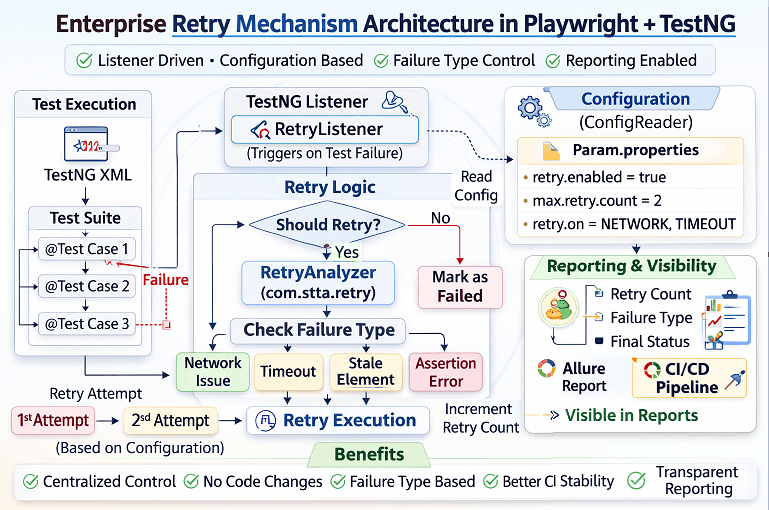
The enterprise retry strategy is designed to be centralized, predictable, and easy to control at scale. Instead of embedding retry rules inside individual tests, the framework uses a single, high-level retry mechanism that applies consistently across the entire test suite.
At the core of this design is a listener-driven retry approach. The listener intercepts test execution events and decides whether a test should be retried. This keeps retry behavior outside test logic and ensures all retries follow the same rules.
The design follows a clear separation of concerns:
- Retry decision logic determines when a retry is allowed, such as failures, timeouts, or skips
- Retry configuration is managed through the Param.properties file, allowing changes without code updates
- Test execution flow remains clean, focused only on validation and business logic
This architecture scales well for enterprise teams because it supports large test suites, multiple contributors, and CI-driven execution. Retry behavior stays consistent, configurable, and easy to evolve as the framework grows.
Configuration Driven Retry Control
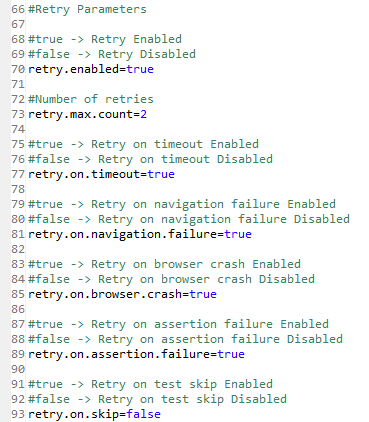
In an enterprise Playwright framework, retry behavior must be flexible and environment-aware. This is achieved using configuration-driven retry control defined in the Param.properties file. Instead of changing code, teams can tune retry behavior using simple flags.
The retry enable switch acts as a global control. When enabled, retries are applied across the framework. When disabled, all tests run without retries. This is useful when you want strict execution in stable environments.
The maximum retry count defines how many times a failed test can be re-executed. This prevents infinite retries and ensures predictable execution time in CI pipelines.
Failure-type-based retry control allows retries to be triggered only for specific failure scenarios such as timeouts, navigation failures, browser crashes, or assertion failures. This avoids masking real defects.
Most importantly, this setup supports environment-level control. Local runs, CI pipelines, and prod-like executions can each have different retry strategies without any code changes.
Failure Type-Based Retry Handling
In an enterprise-grade automation framework, retry behavior must be flexible. Different teams, environments, and execution goals demand different retry strategies. That is why all retry failure types can be independently turned on or off through configuration.
As recommended in the official Playwright retry documentation, retries are best suited for environmental or infrastructure-related failures rather than genuine product defects.
Assertion failures are usually a sign of real functional defects. By default, many teams prefer to disable retries for assertions. However, the framework allows enabling assertion retries when dealing with known flaky validations.
Timeout issues often occur due to slow CI agents or temporary load on shared infrastructure. These are safe candidates for retries and can be enabled or disabled based on environment stability.
Navigation failures are commonly caused by transient network or page load issues. Retry for these failures can be toggled when running tests in unstable environments.
Browser crashes are infrastructure-related failures. Retrying such cases helps reduce false negatives without hiding product issues.
Skipped tests remain excluded from retries, as skipping is a deliberate execution decision.
This configuration-driven control ensures retries improve stability without masking genuine defects.
Retry Listener Integration in Enterprise Framework
In an enterprise Playwright framework, retry behavior should never be controlled at the individual test level. This is where a TestNG annotation transformer plays a critical role. The transformer automatically attaches the retry analyzer to every test at runtime, without modifying any test class.
A listener-based retry approach is preferred in enterprise frameworks because it enforces consistency. All tests follow the same retry rules, and no team can accidentally introduce custom retry logic that breaks standard behavior.
Since retries are injected centrally, test cases remain completely independent of retry logic. Tests focus only on validation and business flow, while the framework controls execution behavior.
From a stability perspective, this approach reduces configuration drift across large suites. It also improves reporting accuracy, as retries are tracked centrally and reflected consistently across CI runs, logs, and test reports.
Configuration Reader Role in the Retry Mechanism
In an enterprise-scale Playwright framework, direct access to property files inside retry logic is intentionally avoided. Reading configuration values inline increases duplication, reduces clarity, and makes future changes risky.
A centralized ConfigReader acts as the single source of truth for all retry-related configuration. It abstracts how and from where values are loaded, allowing retry logic to remain clean, readable, and focused only on decision making.
This design provides several enterprise-level benefits. Default fallback handling ensures safe execution even when properties are missing or misconfigured. Type-safe access prevents runtime parsing issues in CI pipelines. As a result, retry logic stays simple and expressive without defensive checks scattered across the code.
From an enterprise readiness perspective, this approach supports long-term maintainability, easier environment-specific tuning, and predictable behavior across large test suites.
Reporting and Retry Visibility
In an enterprise Playwright framework, retries must be clearly visible in test reports. When a test is retried, reporting tools should reflect each attempt instead of silently converting failures into passes. This ensures teams understand whether a test passed on the first run or only after retries.
Retry transparency matters because enterprise decisions rely heavily on test metrics. Hidden retries can inflate pass rates and mask flaky behavior. Over time, this leads to reduced trust in automation results and delayed defect detection.
A best practice is to track retry counts and clearly label retried executions in reports. Final status should be shown along with retry history, making flaky tests easy to identify and prioritize for fixes.
From a CI pipeline perspective, visible retries help teams tune retry configurations per environment and prevent unstable tests from silently entering production like pipelines.
Download New and Updated Files
This section covers all the files introduced or updated in this step of the Playwright Enterprise Automation Framework. These changes together enable a fully centralized, configuration-driven retry mechanism.
Download Step 18 Updated Files
Files included in this step
- New files added
RetryAnalyzeradded under the new packagecom.stta.retryRetryListeneradded under the new packagecom.stta.retryConfigReaderadded under the existing utility packagecom.stta.utility
- Updated files
- testng.xml has been updated to register the retry listener at the suite level, enabling centralized retry handling
- Param.properties now includes retry enablement switches along with failure type-specific control flags
Important Notes
Retries should never be used to hide real product defects. If a test consistently fails due to a functional issue, retrying it only delays defect discovery and creates false confidence.
In an enterprise framework, retries must be reserved strictly for non-deterministic failures such as infrastructure instability, network delays, or transient browser issues. Business logic failures should always fail fast and demand investigation.
Keep the retry count as low as possible in CI pipelines. Excessive retries increase execution time, reduce signal quality, and make test results harder to trust. A minimal, well-controlled retry strategy ensures stable pipelines without masking genuine issues.
Conclusion
A well-designed playwright retry mechanism is essential for building stable and trustworthy enterprise automation. By centralizing retry logic and controlling it through configuration, teams can handle unavoidable flakiness without scattering retry rules across test cases.
This configuration-driven approach allows retry behavior to be adjusted per environment without code changes. As a result, enterprise teams gain flexibility while keeping test execution predictable and maintainable.
Most importantly, this design improves pipeline stability without compromising test quality. Retries are applied only where they make sense, ensuring real defects are not hidden while non-deterministic failures are handled gracefully. This balance is what makes a retry mechanism truly enterprise-ready.
FAQs
What is a Playwright retry mechanism?
A Playwright retry mechanism re-runs failed tests automatically based on configured conditions such as timeouts or browser-related failures.
Why should retries be centralized in an enterprise framework?
Centralized retries ensure consistent behavior across all tests and allow retry rules to be changed through configuration without modifying test code.
Which failures should be retried in Playwright?
Only non-deterministic failures like timeouts, navigation issues, or browser crashes should be retried. Assertion failures usually indicate real bugs.
How do configuration-driven retries help CI pipelines?
They improve CI stability by allowing retries to be enabled or disabled per environment while keeping test behavior predictable and controlled.
How many retries are recommended in enterprise automation?
One or two retries are usually sufficient. Higher retry counts risk hiding genuine product defects and reducing result reliability.